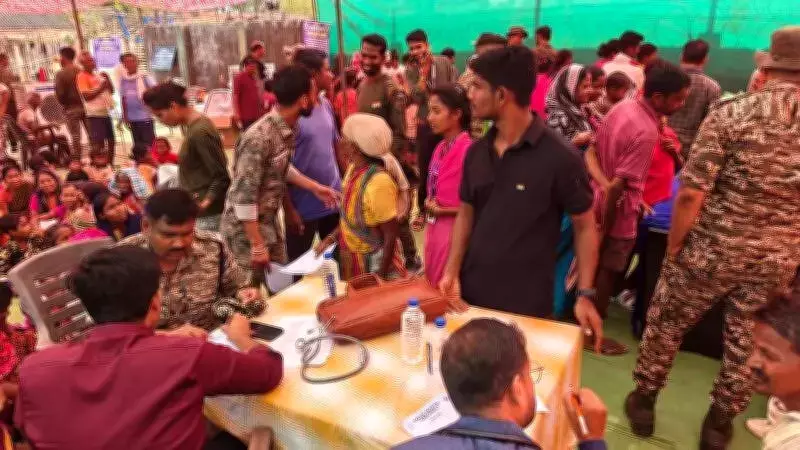
Nagpur: The once impenetrable Abujmarh hills — the rugged, booby-trapped former headquarters of the People's Liberation Guerrilla Army (PLGA) — are witnessing a paradigm shift in the approach of security forces, who are now carrying medical kits and smartphones into the deep. The same commandos who once hunted Maoists in Abujmarh and its foothills have now converted forward operating bases (FOBs) into health hubs. Top Nagpur hospitals have been roped in to extend specialty consultation through telemedicine to the tribals, long denied essential healthcare.
Telemedicine Integration Under e-Sanjeevani Platform
Gadchiroli Superintendent of Police M Ramesh said security forces' deep access in these areas has turned into a unique advantage. "Our teams of police and paramilitary doctors are already supporting FOB-based health camps, gram bhets and weekly bazaars. With telemedicine, even complex cases can now be reviewed live by Nagpur's top specialists without forcing tribals to travel hundreds of kilometres," he said.
The real gamechanger was the integration of telemedicine under the e-sanjeevani platform. "Patients identified during these camps are instantly connected to super-specialists in different Nagpur hospitals. Police doctors provide immediate on-site treatment and medicines, while specialists in Nagpur guide diagnosis, treatment plans and follow-ups in real time," said the SP.

Collaborative Healthcare Outreach
The healthcare outreach programme in the once inaccessible areas has been launched in collaboration with medical teams of the district hospital and CRPF. Doctors from Gadchiroli Police Hospital, CRPF medical facilities and the district hospital are regularly organising health camps in sensitive pockets such as Nelgunda, Mannerajaram, Bangadi and other remote villages. These camps focus on maternal and child health, malnutrition, geriatric care, sickle cell disease and other tribal-specific ailments through focused screening, counselling and specialist intervention through telemedicine.
Sessions are being held through video conferences for early detection and better management of malaria, led by the medical officer and district malaria technical supervisor.
Encouraging Results
Recent joint health camps have yielded encouraging results. "Medical teams comprising chief medical officers, gynaecologists, physicians, paediatricians, ophthalmologists, ENT specialists and CRPF doctors have examined at least 1,600 tribals across multiple camps," said a police official. Cases that once required dangerous, multi-day treks through dense forests are now being managed within hours.
"Where PLGA commanders once operated freely, police outposts are now hosting health camps and telemedicine centres replacing bullets with bandwidth and fear with hope," said the Gadchiroli SP.