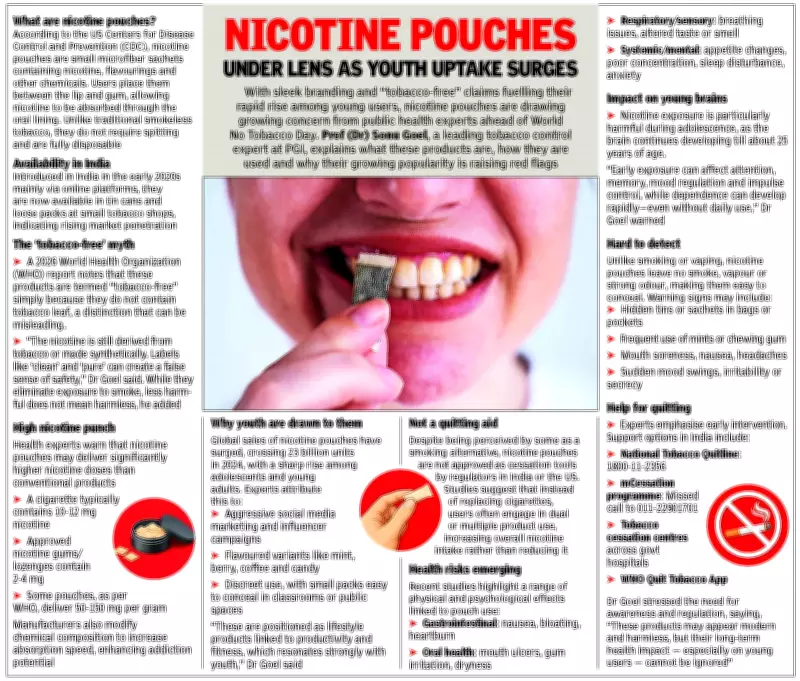
With sleek branding and 'tobacco-free' claims fueling their rapid rise among young users, nicotine pouches are drawing growing concern from public health experts ahead of World No Tobacco Day. Prof (Dr) Sonu Goel, a leading tobacco control expert at PGI, explains what these products are, how they are used and why their growing popularity is raising red flags.
What Are Nicotine Pouches?
According to the US Centers for Disease Control and Prevention (CDC), nicotine pouches are small microfiber sachets containing nicotine, flavorings and other chemicals. Users place them between the lip and gum, allowing nicotine to be absorbed through the oral lining. Unlike traditional smokeless tobacco, they do not require spitting and are fully disposable. Introduced in India in the early 2020s mainly via online platforms, they are now available in tin cans and loose packs at small tobacco shops, indicating rising market penetration.
The 'Tobacco-Free' Myth
A 2026 World Health Organization (WHO) report notes that these products are termed 'tobacco-free' simply because they do not contain tobacco leaf, a distinction that can be misleading. 'The nicotine is still derived from tobacco or made synthetically. Labels like 'clean' and 'pure' can create a false sense of safety,' Dr Goel said. While they eliminate exposure to smoke, less harmful does not mean harmless, he added.

High Nicotine Punch
Health experts warn that nicotine pouches may deliver significantly higher nicotine doses than conventional products. A cigarette typically contains 10–12 mg nicotine, approved nicotine gums or lozenges contain 2–4 mg, while some pouches, as per WHO, deliver 50–150 mg per gram. Manufacturers also modify chemical composition to increase absorption speed, enhancing addiction potential.
Why Youth Are Drawn to Them
Global sales of nicotine pouches have surged, crossing 23 billion units in 2024, with a sharp rise among adolescents and young adults. Experts attribute this to aggressive social media marketing and influencer campaigns, flavored variants like mint, berry, coffee and candy, and discreet use, with small packs easy to conceal in classrooms or public spaces. 'These are positioned as lifestyle products linked to productivity and fitness, which resonates strongly with youth,' Dr Goel said.
Not a Quitting Aid
Despite being perceived by some as a smoking alternative, nicotine pouches are not approved as cessation tools by regulators in India or the US. Studies suggest that instead of replacing cigarettes, users often engage in dual or multiple product use, increasing overall nicotine intake rather than reducing it.
Health Risks Emerging
Recent studies highlight a range of physical and psychological effects linked to pouch use, including gastrointestinal issues such as nausea, bloating and heartburn; oral health problems like mouth ulcers, gum irritation and dryness; respiratory and sensory issues such as breathing difficulties, altered taste or smell; and systemic and mental effects including appetite changes, poor concentration, sleep disturbance and anxiety.
Impact on Young Brains
Nicotine exposure is particularly harmful during adolescence, as the brain continues developing till about 25 years of age. 'Early exposure can affect attention, memory, mood regulation and impulse control, while dependence can develop rapidly—even without daily use,' Dr Goel warned.
Hard to Detect
Unlike smoking or vaping, nicotine pouches leave no smoke, vapor or strong odor, making them easy to conceal. Warning signs may include hidden tins or sachets in bags or pockets, frequent use of mints or chewing gum, mouth soreness, nausea, headaches, and sudden mood swings, irritability or secrecy.
Help for Quitting
Experts emphasize early intervention. Support options in India include the National Tobacco Quitline at 1800-11-2356, the mCessation programme via missed call to 011-22901701, tobacco cessation centers across government hospitals, and the WHO Quit Tobacco App. Dr Goel stressed the need for awareness and regulation, saying, 'These products may appear modern and harmless, but their long-term health impact—especially on young users—cannot be ignored.'