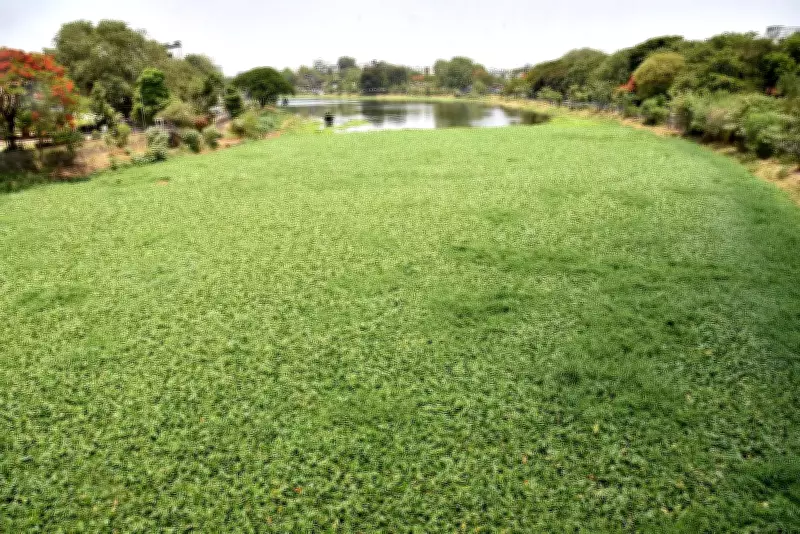
Nashik: Water hyacinth has once again covered the Godavari River stretch from Ahilyabai Holkar Bridge upstream to Ramwadi Bridge, exacerbating pollution levels in the river. The civic body had cleared the water hyacinth from the same stretch last month, but it has reappeared.
Failure of Civic Body
Despite the Nashik Municipal Corporation (NMC) possessing a trash skimmer machine designed to remove water hyacinth, the civic body has failed to carry out the removal work on a regular basis. This has led to the rapid regrowth of the invasive aquatic plant.
Environmental Activist's Concerns
Environmental activist Rajesh Pandit stated, "The growth of water hyacinth is caused by the mixing of sewage with river water. Untreated sewage discharge into the Godavari is also leading to its spread. The only permanent solution is to stop the release of sewage into the river."

Short-Term Measures Planned
The NMC is planning to remove the water hyacinth manually by deploying manpower through outsourcing as a short-term measure. The issue was raised during a meeting on Godavari river pollution chaired by Nashik Divisional Commissioner Praveen Gedam about three months ago. Taking note of the issue, the divisional commissioner directed the NMC to either procure another trash skimmer machine or carry out manual removal. Following this, the civic body placed a proposal before the general body for manual cleaning of the river, which was recently approved.
Mayor and Commissioner's Statements
Speaking to reporters, Nashik Mayor Himgauri Aaher said the NMC is planning to remove the water hyacinth manually alongside the use of the trash skimmer machine. NMC Commissioner Manisha Khatri said the issue is expected to be resolved once the new sewage treatment plants (STPs) become operational by March 2027.
Long-Term Solutions
At present, the biological oxygen demand (BOD) level of treated sewage water from the existing STPs ranges between 20 and 25 mg/litre. However, the BOD level of treated wastewater from the new STPs is expected to be below 5 mg/litre, which is likely to curb the growth of water hyacinth. The new STPs are anticipated to significantly reduce pollution and prevent the recurrence of water hyacinth in the river.