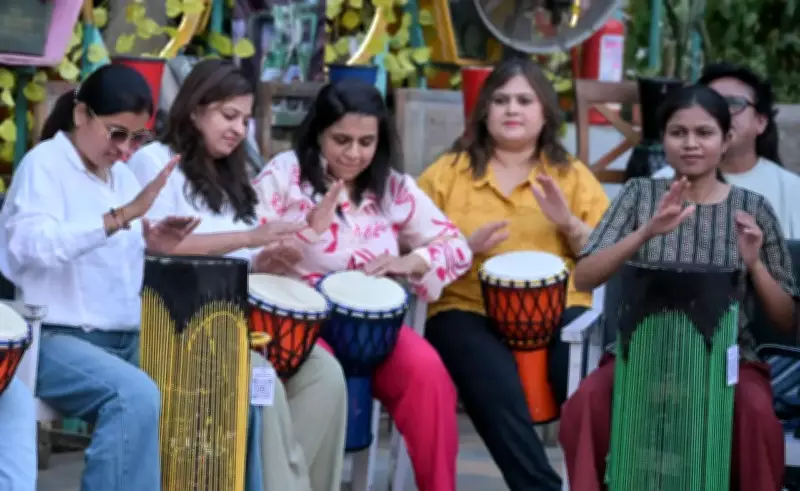
In a rare community where generations connect, gender fades, and rhythm takes over, a three-year-old sits beside a 60-year-old, both playing drums. Drum circles break away from traditional musical gatherings, eliminating the performer-audience gap. There is no stage, hierarchy, or set list, but rather community connection and expression. While not new to Pune, these circles remain popular, offering a space for Punekars to gather, take a break from daily rush, and unwind with music.
What’s Fuelling the Popularity?
Simplicity, accessibility, and music as therapy are key highlights. Within minutes of a session, participants forget their phones and become fully present. “People feel grateful for having a non-judgemental space, and for not having to think about anything else in those moments,” said Varun Vishvesh, facilitator and head of Innovent Drum Circles. Their monthly community drum circle has grown from 20-25 people to 400 people in roughly six years. The ease of sessions also helps. “People walk in shy and reserved, but leave laughing and enjoying themselves,” said Preyas Kansara, facilitator and founder of Team Dhunn.
Rhythm Meets Healing
Varun Venkit of Taal Inc., founded in 2005 and considered a pioneer of group drumming in India, shared reports from their ongoing arts and health intervention, Art Talks. “We have observed reports of feeling a sense of belonging, release (catharsis), lightness, and community after the sessions,” said Varun. While one session can feel transformative, he insists the real magic lies in consistency. “If you feel one session is amazing, try drumming over a period of time and watch as the magic unfolds effortlessly,” he added.

The Community Pull
One of the strongest draws is community connection. There are no barriers to entry, and inclusivity is both deliberate and organic. “Drumming is a powerful medium for emotional release and connection. Some of our youngest participants are three years old. One of our oldest participants was 98,” said Yudi Dhawale, who started Pune Drum Circle inspired by African tribal communities’ connection to rhythm. Sunil Tendulkar, father of three-year-old Swarup, a regular at drum circles, said, “Swarup instantly connected with the rhythm and energy. His confidence in groups has soared.” For Shireen, a teacher, the drum circle feels like a space for emotional release. “A drum circle beautifully blends music, community, and personal healing,” she said.
What’s a Drum Circle?
It is a gathering where people play drums together, usually seated in a circle. Everyone participates as one, led by a trained facilitator. Core instruments include Djembe, Dununba, Kenkeni, Ashiko, Conga, Tambourine, woodblock, finger cymbals, and even DIY sand-filled containers.
At a Drum Circle
- Listen before you play
- Sync with the group’s rhythm
- Avoid overpowering others
- Respect shared instruments and space
- Stay open, inclusive, and non-judgemental
Why It Ticks Boxes
- Stress relief through rhythmic movement
- Improved coordination, focus, and sense of timing
- Sense of belonging and shared creativity
- Freedom to participate without pressure
- Provides emotional release for some
- Ritual to unplug
With its deep tones, the Djembe sits at the heart of drum circles, helping create a pulsating energy.