One of the most piercing questions that haunts humanity is also one of the simplest: Why do bad things happen to good people? When a person lives with integrity, shows kindness to others, and yet is met with loss, illness, betrayal, or relentless failure, the cry of "Why me?" feels both natural and deeply painful, especially when the suffering seems entirely undeserved.
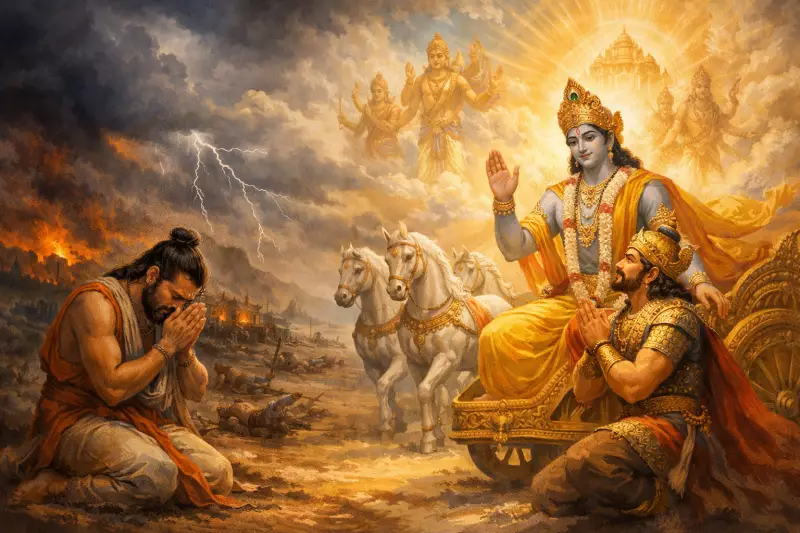
The ancient Hindu scripture, the Bhagavad Gita, does not shy away from this agonizing query. Instead of offering a dismissive platitude, it approaches the dilemma with serene clarity. It provides an explanation that moves beyond assigning blame and instead fosters a deeper understanding of life's fundamental mechanics.
The Multilayered Law of Karma
A cornerstone of the Gita's teaching is the immutable law of karma—the principle of action and consequence. However, the scripture clarifies a common misconception: karma is not a simplistic moral scorecard that doles out instant rewards for good behavior or immediate punishment for wrongdoing. The Gita presents karma as complex, cumulative, and frequently spanning across multiple lifetimes.

This profound perspective means that present circumstances may not be a direct reflection of who a person is now, but rather the unfolding of seeds planted by actions taken earlier—sometimes in a distant past beyond current memory. Therefore, a virtuous individual enduring hardship is not necessarily being punished. They may be exhausting past karmic momentum. The Gita reminds us that karma operates on its own cosmic timeline, independent of human notions of fairness and justice.
Suffering Is Not Always Personal
In his discourse to the warrior Arjuna, Lord Krishna repeatedly guides him away from a mindset of personal victimhood. Life, Krishna explains, is governed by forces much larger than individual desire—such as time (kala), nature (prakriti), and universal duty (dharma).
Many events occur not because a person deserves them, but because they are part of a vast, interconnected flow. A storm does not assess moral character before striking. Disease does not ask for consent. Loss does not bargain for fairness. The Gita teaches that interpreting every hardship as a personal injustice only amplifies and deepens the suffering. Recognizing that some pain is impersonal—an inherent aspect of existence itself—can soften our resistance and reduce inner turmoil.
The High Cost of Attachment
A powerful insight from the Gita is that the intensity of pain is often magnified by the strength of our attachments. The more tightly we cling to specific outcomes, identities, or expectations, the more devastating it feels when life inevitably changes course. This is not to say that caring is wrong, but that clinging is costly.
The text explains that a good person may suffer more acutely precisely because they feel deeply, hope sincerely, and invest themselves fully. When those heartfelt expectations are shattered, the hurt cuts sharper. The detachment (vairagya) advocated by the Gita is not cold indifference. It is the cultivated ability to act with full sincerity and heart while remaining inwardly steady and balanced when results do not match our hopes.
Suffering as a Spiritual Teacher
Unlike belief systems that frame suffering purely as divine punishment, the Bhagavad Gita presents hardship as a potential teacher. Difficult experiences are described as moments that can strip away illusions—illusions about our control, the permanence of situations, and even our fixed identity.
Pain has the capacity to humble the ego and bring clarity to our true priorities. Many verses emphasize that genuine growth and strength rarely emerge from a place of comfort. Discernment, resilience, and profound compassion often blossom only after a season of inner struggle. The Gita does not glorify suffering, but it suggests that pain can refine our awareness when met with mindful reflection instead of bitter resentment.

The Eternal, Untouched Soul
Perhaps one of the most comforting teachings in the Gita is its clear distinction between the body, the mind, and the soul (atman). According to Krishna, the soul is eternal, immutable, and untouched by the temporary losses or injuries of the material world. What suffers is the body-mind complex, not the true, essential self.
When adversity strikes, the Gita encourages a subtle but powerful shift in identity—from "this is happening to me" to "this is happening in life." This perspective does not erase physical or emotional pain, but it prevents that pain from defining one's core worth or ultimate destiny.
Acting Without Bitterness: The Ultimate Answer
The Gita's most practical wisdom lies in its counsel to act without bitterness. Fulfilling one's duty (svadharma) with integrity and righteousness, even amidst profoundly unfair circumstances, is presented as the pinnacle of spiritual strength. A person's character is not defined by what happens to them, but by how they choose to respond.
Krishna instructs Arjuna that righteousness (dharma) is not a tool to escape suffering. It is the means to remain anchored in clarity and purpose while moving through it. When our actions are guided by intrinsic values rather than attachment to specific outcomes, a profound peace becomes possible even in the midst of chaos.
The Bhagavad Gita does not promise a life free from pain for the virtuous. What it offers is something more profound and enduring: freedom within pain. It teaches that suffering is not evidence of personal failure, nor is goodness a magical shield against life's hardships. Existence unfolds according to laws that are vaster than individual virtue.
Bad things happen not because goodness is ignored, but because life, in its very nature, is complex and interconnected. The Gita's final reassurance is simple yet transformative: You are always more than what happens to you.