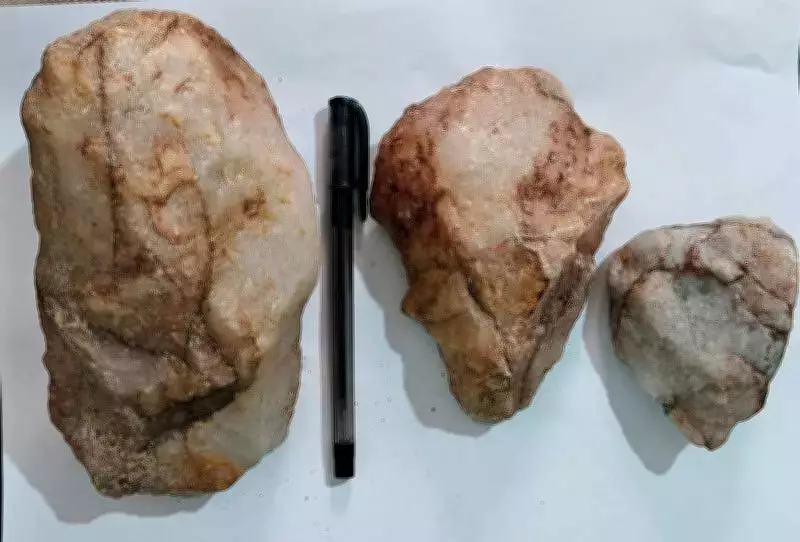
Ancient Stone Tools Discovered in Hyderabad Forest, Dating Back 600,000 Years
In a significant archaeological find, Lower Palaeolithic stone tools have been identified on the banks of a water channel along the Manchirevula forest track in Gandipet mandal of Ranga Reddy district. This discovery adds to the growing record of prehistoric finds on the outskirts of Hyderabad, shedding new light on early human habitation in the region.
Discovery Made by Environmental and Historical Groups
The discovery was made by Mir Omar Ali Khan, vice-president of Climate Front Telangana, and Sriramoju Haragopal, convener of Kotha Telangana Charitrabrundam. Their fieldwork in the forest area led to the identification of these ancient artefacts, which were found in sand excavated beside a small stream and a water channel dug to collect water in the forest stretch.
Five Artefacts Found in Streamside Excavation Area
The finds include:

- Three hand axes
- One flake tool
- One core prepared for making stone tools
The measurements and weights of the hand axes are particularly notable:
- The first quartz hand axe measured 24 cm in length, 27 cm in circumference, and weighed 130 grams.
- The second hand axe was 15 cm long, had a circumference of 21 cm, and weighed 45 grams.
- The third hand axe was 9 cm long, had a circumference of 17 cm, and weighed 30 grams.
Expert Links First Tool to Lower Palaeolithic Phase
Retired professor Ravi Korisettar, an archaeologist associated with Dharwad and known for his work on the South Asian Lower Palaeolithic, identified the first tool as belonging to the Lower Palaeolithic period. He expressed surprise at the successive discovery of such ancient tools in the area.
In the Indian prehistoric sequence:
- The Lower Palaeolithic is generally placed from about six lakh years ago to 1.5 lakh years ago.
- The Middle Palaeolithic is dated roughly from 1,50,000 BCE to 35,000 BCE.
- The Upper Palaeolithic spans from about 35,000 BCE to 10,000 BCE.
Earlier Finds Point to Long Human Presence
The latest find gains significance because Middle Palaeolithic-era rock art and stone tools were earlier reported from the same Manchirevula forest track. Hyderabad has also yielded prehistoric evidence at BNR Hills, where reports in 2023 noted Neolithic stone axes and a prehistoric rock shelter.
Haragopal emphasized that the spread of prehistoric evidence across the city and its outskirts underlines the urgent need to protect such remains from urban expansion and preserve them for future generations. "These discoveries are not just archaeological curiosities," he noted, "but vital links to understanding human history in this region."
The discovery highlights how Hyderabad's landscape continues to reveal secrets of ancient human activity, with each find adding another piece to the puzzle of early settlement patterns in South India.