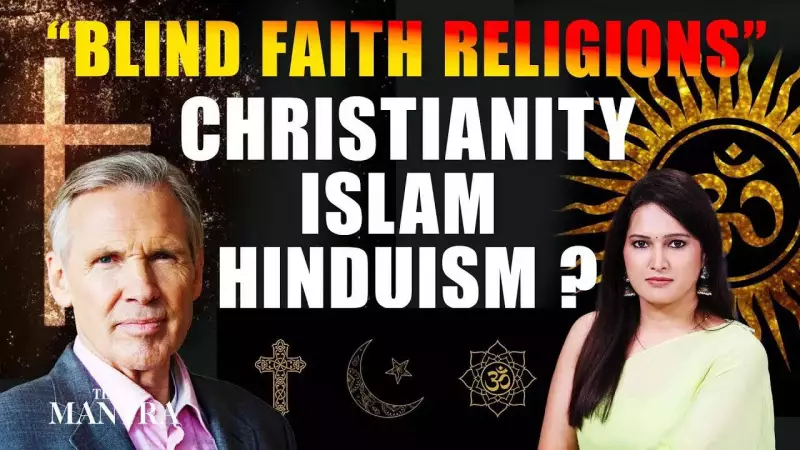
In a move that has ignited widespread discussion across spiritual circles, author and speaker Jeffrey Armstrong has taken a bold stand against the practice of blind faith within the world's major religions. On December 26, 2025, Armstrong's pointed critique of unquestioned beliefs in Hinduism, Islam, and Christianity sparked a fresh debate on the role of tradition and personal inquiry in modern society.
A Call for Critical Examination of Beliefs
Armstrong's central argument challenges followers to move beyond habitual rituals and inherited doctrines. He posits that true spiritual understanding cannot arise from passive acceptance but must be forged through active questioning and intellectual engagement. His perspective frames this inquiry not as an act of disrespect towards ancient traditions, but as a necessary step towards achieving a more profound and personal connection with spiritual truths.
"Questioning tradition is not disrespect, but a step toward deeper understanding," Armstrong asserts. His work encourages individuals to embark on a personal quest for truth, suggesting that authentic faith is compatible with reason and critical thought. This approach directly confronts the concept of following religious practices purely out of habit or societal pressure.

Sparking a National Conversation on Faith
The implications of Armstrong's views have resonated deeply in a country like India, where diverse religious practices are integral to the cultural fabric. His commentary forces a 21st-century relook at how centuries-old beliefs are interpreted and lived today. The debate touches upon core questions: Where is the line between devout faith and blind obedience? Can religious institutions withstand scrutiny from within?
Reactions have been predictably mixed. While some applaud his courage in advocating for a more mindful and individualized spiritual path, others view his statements as disruptive to religious harmony and an oversimplification of complex theological frameworks. The controversy underscores the ongoing tension between established religious authority and the modern individual's quest for autonomous belief.
The Path Forward: Mindful Faith in a Modern Age
Regardless of where one stands on the issue, Jeffrey Armstrong's intervention has successfully placed a critical topic back on the table. It compels believers and skeptics alike to examine the foundations of their own beliefs. The discussion moves beyond mere criticism, aiming instead to foster a culture where faith and reason are not seen as opposites but as complementary forces on the journey of spiritual growth.
As this conversation unfolds, it highlights a growing global trend where individuals, especially the youth, seek spirituality that is both rooted and rational. Armstrong's controversial yet thought-provoking stance serves as a catalyst for this important, if difficult, dialogue about the future of faith in an increasingly interconnected and questioning world.