Leadership Change at Kochi-Muziris Biennale Amid Ongoing Challenges
The Kochi-Muziris Biennale always generates drama, and this year proves no exception. We are now one month into the sixth edition of this major art event. Bose Krishnamachari, the biennale's president, has resigned from his position. He also stepped down from the board. This development adds to a history of troubles for the biennale. Previous editions faced financial difficulties, infrastructure problems, and disputes over artistic freedom.
Just last month, curators removed a painting by artist Tom Vattakuzhy. Religious groups claimed the work hurt their sentiments. This year's theme is "for the time being." The curation ranges from deeply moving pieces to utterly strange installations. The event continues until March 31. It spans 22 different venues and features more than 60 artists. If your time is limited, this guide highlights the must-see works.
Essential Stops at Aspinwall House
Do not try to see everything at the vast Aspinwall House. Focus on key installations instead. Visit the Panjeri Artists' Union corner first. This collective includes artists, academics, activists, and students. Their work examines how ordinary lives change under economic, social, and political pressures.

Right next to it, you will find Dhiraj Rabha's The Quiet Weight of Shadows. This piece draws from Rabha's personal experiences with militancy in Assam. It makes viewers think about resistance, surveillance, and displacement. Walk across the courtyard to see Bhasha Chakrabarti's textile art. Her work, Diasporic Transcriptions, explores ideas of women's labor. It celebrates the sisterhood formed around unpaid work, shared chores, and housekeeping.
Highlights on Bazar Road
Head to Anand Warehouse on Bazar Road. A room there holds old wooden chairs from public institutions across Kerala. Local carpenters repaired these chairs. They are arranged in a half-elliptical shape, reminiscent of an old durbar. The walls feature discarded sacks sewn together by women from Kochi.
This installation is Ibrahim Mahama's Parliament of Ghosts. The Ghanaian artist critiques conversations by those in power. He highlights how they often neglect the real concerns of laborers and traders outside government institutions. The work is part of an international series. It offers sharp criticism but also creates a surprisingly joyful space.
Across the road, the Edam exhibition showcases diverse art from Kerala. It includes powerful, imaginative paintings by Tom Vattakuzhy. These works originally served as magazine illustrations for various Malayalam short story writers.
The Edam exhibition continues at Cube Art Space further down Bazar Road. One show there examines the many meanings drawn from the final moments of M.K. Gandhi's life. A short distance away in Jew Town, find the Monsoon Collective's The Emperor's New Clothes. This display shows how clothing has shaped history and identity in Kerala.
Powerful Installations at Ginger House
Entering Ginger House involves walking through a massive antique store. You pass life-sized theyyam figurines and winged creatures. This creates a mood quite opposite to Shilpa Gupta's Listening Air (2019-23).
Gupta's first installation, Sound on My Skin, brings you back to earth immediately. It features a flapboard that looks like it announces flight arrivals. Instead, it whirs and flips to show seemingly disconnected words and phrases. Viewers slowly realize these form a political statement. They comment on the law, blind acquiescence, and circumstances that force people to "cancel your protest... for your own safety."
The truly outstanding work here is Listening Air. This installation includes protest songs, microphones, speakers, and stools set in a circle. Entering the dark room from bright sunlight creates a sense of apprehension. It feels like walking into a protest, unsure of what will happen.

Protest anthems from around the world play here. You hear Bella Ciao, Hum Dekhenge, No nos moverán. The initial unease slowly gives way to a feeling of joyful fraternity. It captures the hopeless camaraderie of fighting for a cause that will likely be crushed. This demanding show requires viewer engagement. Consider a restorative fresh lime water at the sea-facing Museum Hotel café next door before moving on.
Major Works at Island Warehouse
Opposite the Water Metro station on Willingdon Island lies a massive 20,000 sq. ft space. It hosts large installations by LaToya Ruby Frazier, Marina Abramović, and Arti Kadam. These works remind us to pay closer attention to what is in front of us.
The most captivating piece is Dineo Seshee Bopape's Mme, Mmu, Bhumi, Bhumi. The South African artist creates anthill-like forms from dung. These forms also resemble huts. In her culture, they are sacred. They look very similar to the large anthills worshipped in parts of India. The work serves as a reminder of shared culture in a world that seems increasingly fractured.
The Palakkad-based Lakshmi Nivas Collective also presents work here. Their pieces explore themes of nature and restoration. They invite visitors to linger and reflect.
A Master's Retrospective Offers Hope
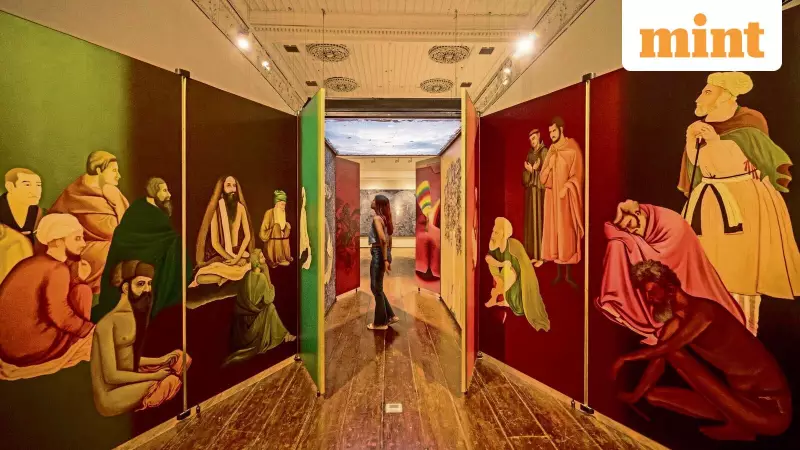
A thread of hopelessness runs through many works at the biennale. They often focus on fracture and decay. Gulammohammed Sheikh's massive exhibition provides a contrasting ray of light. It is housed at Durbar Hall in Ernakulam on the mainland.
Of Worlds Within Worlds is a grand retrospective of this 87-year-old master's work. It was on display in Delhi since February and is now in Kochi for the biennale's duration. The Kiran Nadar Museum of Art facilitates this showing.
Sheikh's work is packed with detail, ideas, history, politics, and literature. It draws from many influences, often surreal and fantastical. All pieces offer severe commentary. They demand complete engagement from the viewer. Yet, one leaves feeling soothed. The exhibition fosters a belief that we can, perhaps, push back against all that is wrong with the world.