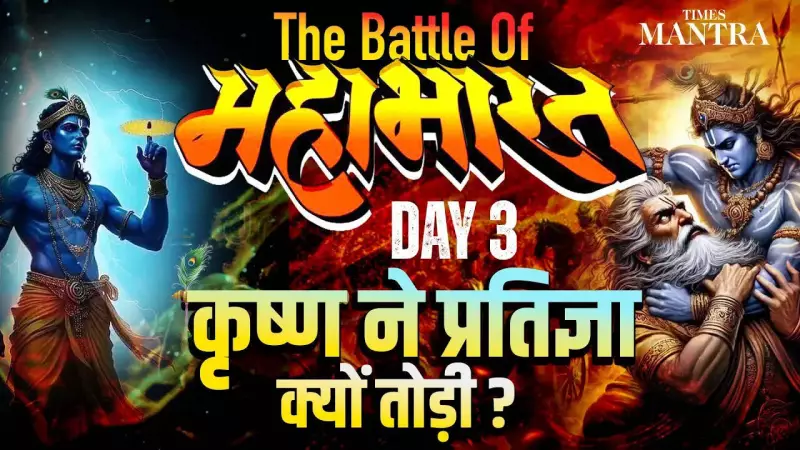
An extraordinary event on the third day of the great Mahabharata war continues to captivate scholars and spiritual seekers. This pivotal moment centers on Lord Krishna, the charioteer of Arjuna, and the profound question of whether He broke a solemn vow by stepping onto the battlefield. Expert KL Upadhyay, in a detailed analysis, unravels the hidden layers of this incident, exploring its deep spiritual symbolism, unparalleled strategic wisdom, and enduring relevance for humanity.
The Pivotal Moment on the Battlefield
As the war raged on Day 3 at Kurukshetra, the situation grew increasingly dire for the Pandava forces. The Kaurava army, led by formidable commanders, was gaining a fearsome upper hand. In the midst of this chaos, Arjuna, the great archer, found his resolve tested as he witnessed the relentless advance. It was at this critical juncture that Lord Krishna, who had taken a vow at the war's outset not to raise any weapon, made a move that seemed to defy His own promise.
Witnessing Arjuna's momentary hesitation and the overwhelming pressure, Krishna descended from the chariot. With the divine discus, the Sudarshana Chakra, in hand, He rushed toward the enemy lines. This dramatic action sent shockwaves across the battlefield. For a moment, it appeared that the divine charioteer was about to abandon His role and enter the fray directly, seemingly breaking His sacred vow of non-participation in combat.

Spiritual Symbolism and Strategic Genius
KL Upadhyay explains that this was far more than a simple breach of promise. This act was a multilayered divine intervention designed to uphold the principles of dharma, or cosmic order. Krishna's move served as the ultimate test for Arjuna. It forced the warrior to confront the immediate reality of the war and snap out of any lingering doubt or attachment that could jeopardize the cause of righteousness.
Strategically, Krishna's advance caused confusion and fear among the Kaurava ranks, momentarily disrupting their formation and momentum. This provided the Pandavas with a crucial window to regroup. Spiritually, the incident symbolizes that the divine principle (Krishna) is always ready to intervene when dharma is under severe threat, but the ultimate action must be taken by the human devotee (Arjuna) who has been empowered and guided. Krishna's action was not about fighting but about reawakening the warrior spirit in His devotee.
The Deeper Truth and Timeless Relevance
The untold truth, as revealed by Upadhyay, is that Lord Krishna did not actually break His vow. He never used a weapon. His divine purpose was to create a transformative moment that would reshape the course of the war by reigniting Arjuna's focus and duty. This episode underscores a core teaching of the Bhagavad Gita: the Supreme provides guidance and creates opportunities, but the individual soul must choose to act according to righteous duty.
This single moment on Day 3 holds timeless relevance. It teaches lessons in leadership, the nuanced application of principles, and the dynamic nature of protecting righteousness. It shows that divine rules are not about literal rigidity but about fulfilling a higher purpose. The event, often termed a Krishna Leela or divine play, ultimately reinforced Arjuna's resolve, setting the stage for the subsequent days of the epic war and ensuring the eventual victory of dharma.
The analysis by KL Upadhyay, available on Times Mantra, delves into these profound dimensions, offering seekers a clearer understanding of how divine will operates within the framework of human action and cosmic law.