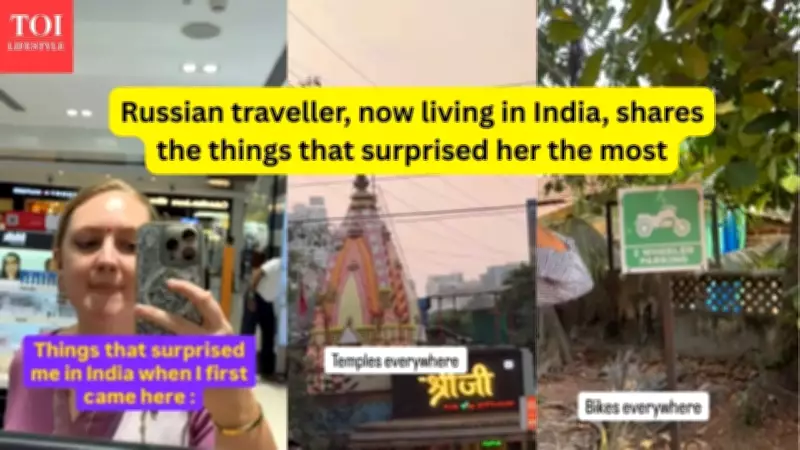
A Russian woman living in India has shared her surprising observations about everyday life in the country, highlighting things that locals often overlook but fascinate newcomers. Alena Kovpar, a Russian national now residing in India, posted a video listing the aspects of Indian life that have truly surprised, confused, or amazed her since moving there.
Stray Dogs and Barefoot Clinics
One of the first things Kovpar noticed was the abundance of stray dogs on Indian streets. Unlike in many European countries, where stray dogs are rare, in India they are a normal part of city life, often seen sleeping outside shops, crossing roads, or becoming local pets. Another unexpected cultural encounter was the sight of people removing their shoes before entering doctors' clinics. While this practice is rooted in notions of cleanliness and cultural tradition, to outsiders, the sight of footwear lined up outside a clinic can seem odd.
Bamboo Scaffolding and Noise
Kovpar was also struck by Indian construction sites, where workers scale bamboo scaffolding without heavy safety equipment common elsewhere. Bamboo scaffolding is an old tradition in South Asia due to its affordability and flexibility, but it can appear surreal to others. The noise level was another shock—constant honking, traffic, street vendors, celebrations, and construction work create a cacophony that is all-encompassing.

Spirituality and Gold
Not all observations were negative. Kovpar found the presence of temples everywhere fascinating—tucked among shops, in residential colonies, along highways, or in busy markets. This made her realize that spirituality is an integral part of Indian life. She also noted the passion for gold and jewellery, which is central to weddings, festivals, and fashion.
Colorful Clothing and Dense Living
Kovpar was fascinated by the colorful and affordable clothing in India, from kurtas and sarees to embroidered fabrics and street fashion. She also observed how densely populated residential areas are, with houses, shops, scooters, food stalls, and temples coexisting in compact spaces. The chaos and efficiency of urban environments amazed her.
Traffic and Religious Diversity
Indian traffic, dominated by scooters and motorbikes that zip around and park in unexpected spaces, seemed like a different planet to her. She was also surprised by the significant Christian population in India, particularly in states like Kerala, Goa, and the Northeast, challenging common stereotypes about the country's religious demography.
Food and Movie Intervals
Food also made the list, with Kovpar joking about the size of thalis—large platters with huge portions that reflect Indian hospitality. But perhaps the funniest observation was movie intervals. In India, movies include a break for snacks, tea, and conversation, which can seem like a theatrical performance to newcomers accustomed to uninterrupted screenings.
Kovpar's observations resonate because they capture the gap between what Indians consider ordinary and what outsiders find unforgettable. Her perspective offers a fresh look at the quirks of daily life in India.