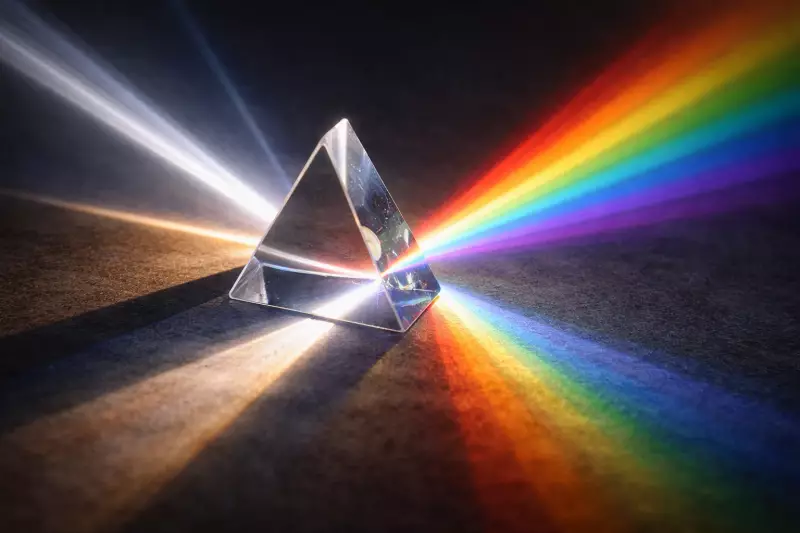
The Wordle puzzle on Christmas Day, December 25, presented players with the word 'prism'. Far from a random choice, this elegantly simple term carries a weight of scientific truth and metaphorical depth, acting as a perfect intellectual gift for the holiday.
The Physical Science: How a Prism Actually Works
In its most basic form, a prism is a transparent, typically triangular object that manipulates light. The magic happens through refraction. When light enters the prism, its speed alters, causing its path to bend or change direction. Crucially, different wavelengths of light bend by different amounts, a process known as dispersion.
This is what creates the beautiful spectrum of colours – violet, indigo, blue, green, yellow, orange, red. The prism doesn't add colour; it separates the components already present in white light. What our eyes perceive as a uniform beam is, in reality, a dense collaboration of multiple wavelengths travelling together. Isaac Newton's classic experiment with sunlight and a glass prism in a darkened room conclusively proved that colour is an inherent property of light itself; the prism merely acts as a revelatory tool.

From Laboratory to Library: The Prism as a Powerful Metaphor
The predictable physics of the prism grants it a rich intellectual life beyond the lab. Its action becomes a compelling argument about human perception. It demonstrates that unity is often an illusion born from a lack of proper tools or patience to see underlying variation. Complexity isn't manufactured by close examination; it is uncovered by it.
Writers and poets have intuitively used this concept long before it was formally named. In literature, the prism functions less as an object and more as a narrative method. Events are filtered through a character's consciousness; truth fractures as it passes through memory, personal bias, and temperament. A single moment can yield multiple, conflicting meanings based on the observer's standpoint.
Modernist authors like Virginia Woolf and William Faulkner heavily employed this prismatic logic. Woolf's prose refracts time into overlapping sensory impressions, while Faulkner's narratives splinter facts into competing voices. The term 'prism-like' admits that some subjects resist simple summary, demanding a multi-faceted view.
Prism in Everyday Culture: A Lens for Analysis
The word has seamlessly entered our daily language as a shorthand for nuanced analysis. We routinely speak of examining politics, identity, history, or trauma through a particular prism. It suggests a framework that separates elements for clarity without causing distortion, acknowledging complexity without descending into chaos.
In an era skeptical of oversimplified, grand explanations, the prism offers a rigorous middle path. It allows us to acknowledge plural perspectives without falling into pure relativism. The emphasis is on achieving clarity through attentive separation, not through reduction.
The enduring power of 'prism' lies in this honest refusal to collapse complexity for convenience. It names an indispensable process: slowing down our perception until differences become visible and accepting that understanding often comes through respectful division, not forced consensus. Whether revealing the true nature of light, modeling the dispersion of meaning, or reminding us that apparent unity often masks hidden diversity, the prism's ultimate gift is one of radical honesty.