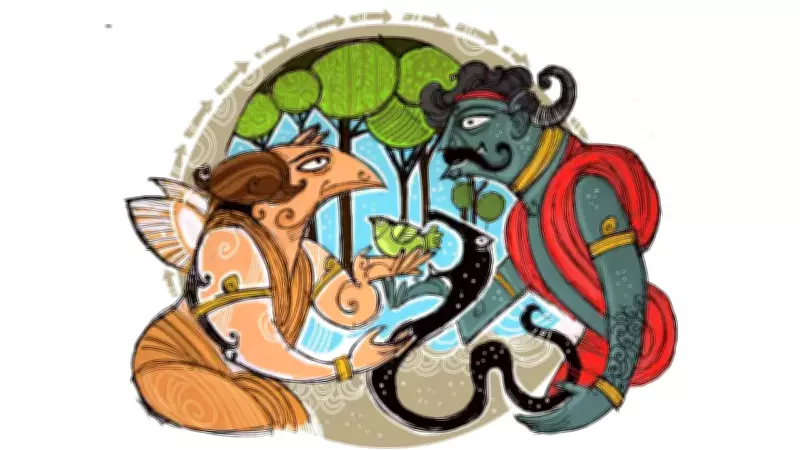
Yama's Philosophical Musings on Immortality and Human Endeavors
Yama, the revered king of the underworld, often contemplated the profound human struggle to achieve immortality. He recognized this as a noble pursuit, one that has historically spurred remarkable works of creativity across art and literature. While physical creations may fade over time due to decay, accidents, or deliberate destruction, the inherent beauty they inspire persists eternally. This enduring essence, Yama reflected, constitutes the true immortal element in any creation, transcending the temporal limits of the material world.
The Ephemeral Nature of Beauty and Its Eternal Resonance
A simple yet profound thought occurred to Yama as he observed a flower: it blooms vibrantly only to wilt eventually. However, the beauty it radiates—its captivating colors, delicate fragrance, and the joy it brings—lingers in the collective memory of the earth. Yama philosophized that the absence of beauty equates to a form of death, drawing from the ancient concept of Brahmn as Satyam Shivam Sundaram (Truth, Goodness, Beauty). He believed that embracing beauty in daily thoughts and actions brings one closer to the divine essence, much like the beautiful sentiment experienced by Garud upon seeing a small bird.
A Divine Encounter at Mount Kailash
During a gathering of gods at Mount Kailash to meet Lord Shiva, Yama arrived and noticed Garud, the divine eagle, stationed at the entrance after delivering his master. Yama smiled at Garud and also spotted a beautiful little bird perched on a nearby tree branch before entering the sacred grounds. Unbeknownst to Yama, Garud was closely monitoring his movements, driven by curiosity about the actions of this feared deity.

Observing Yama's glance at the bird, Garud leaped to a conclusion: he assumed Yama had marked the bird for death, as is his duty with souls whose earthly lives end. Overcome by a protective instinct and panic, Garud swiftly seized the bird and flew across vast seas, ultimately depositing it near a lake in the Dandakaranya forest. He then hurried back to Mount Kailash, arriving just as the gods were departing.
The Revelation of Fate and Duty
As Yama emerged before Lord Vishnu, Garud watched intently, expecting to see his reaction to the bird's absence. With a smug expression, Garud noted Yama looking toward the empty branch and respectfully inquired, "Sire, are you searching for the bird you saw earlier? Why did you take note of it?" Yama responded with a gentle smile, revealing a startling truth: he had foreseen that the bird was destined to be swallowed by a python in the Dandakaranya forest near that very lake. He had wondered how such a small creature could travel so far, as its time of departure from the world was imminent.
Upon hearing this, Garud was struck by a moment of clarity—his vision grew hazy as he realized his own folly. In his attempt to save the bird, he had inadvertently transported it to its predestined death. Yama mused softly, "But something must have happened..." before departing on his buffalo, Mahisha.
Lessons on the Samsaric Cycle and Enduring Beauty
Through this incident, Yama hoped Garud would understand that his role is not one of malevolence but of duty: he merely facilitates the transition of souls whose earthly journeys have concluded, guiding them to their resting places before they re-enter the cycle of rebirth, known as samsar. This eternal cycle underscores the transient nature of physical existence, yet the memory of the bird's beauty and Garud's compassionate sentiment toward it remained etched in Yama's mind, highlighting how beauty and noble intentions persist beyond life's fleeting moments.
Excerpted from 'The Immortal King, Yama' by Sudhamahi Regunathan.