For many years, people were promised that luxury vacations would bring the greatest happiness. Luxurious villas, first-class airline travel, and five-star hotels have long been considered the best way to travel. However, accumulating evidence from various psychological studies reveals a different story: the more you spend on a vacation, the less enjoyment you may derive from it.
Why Budget Travel Creates Stronger Memories and Longer-Lasting Happiness
Budget travel often encourages deeper engagement with places, greater spontaneity, and more meaningful social interactions. Rather than insulating travelers from local culture, it frequently places them closer to it. Psychologists studying happiness and consumer behavior have repeatedly found that experiences tend to create more lasting satisfaction than possessions, particularly when those experiences become stories, memories, and shared moments. The science indicates that what travelers do, feel, and remember often matters far more than how much they spend.
One of the most influential findings in happiness research comes from studies comparing experiential purchases with material purchases. Researchers have consistently found that spending money on experiences generates greater and more enduring happiness than spending money on physical possessions. Travel, whether inexpensive or luxurious, falls squarely into the experiential category. However, budget travel may amplify some of these psychological benefits.

In a landmark study titled 'Spending on Doing Promotes More Moment-to-Moment Happiness Than Spending on Having' published in Psychological Science, researchers Amit Kumar, Matthew Killingsworth, and Thomas Gilovich found that people derive greater happiness from anticipating experiences than from anticipating material possessions. They wrote that 'waiting for an experience tends to be more pleasurable and exciting than waiting to receive a material good.'
This anticipation effect is particularly relevant to budget travelers. Planning train journeys, discovering hidden guesthouses, mapping local markets, and searching for affordable adventures can become part of the experience itself. The holiday begins long before departure.
Researchers further demonstrated that experiential purchases produce greater happiness because they become part of a person's identity. Unlike possessions, experiences are woven into personal narratives and memories. A traveler may forget the thread count of hotel sheets within weeks. The experience of being lost in an old city lane, having tea with locals, or seeing the sun rise from a mountain range is something that one remembers for years to come.
Scientific Studies Show That Experiences Matter More Than Luxury Spending
Studies on the science of happiness prove that experiences are more important than splurging on luxuries. The popular belief is that anything you spend more money on will make you happier. Studies in psychology reveal a different story. A study conducted by Amit Kumar and Thomas Gilovich proved that conversations about experiences can add to happiness. This is because experiences give us stories, which help to develop relationships. They found that people talk more about experiences and enjoy doing so. This is one of the reasons why people often remember their backpacking trips forever.
A broader review published by researchers from the Federal University of Rio Grande do Sul, along with others, described what researchers call the 'experiential advantage,' the consistent finding that spending on experiences such as travel, dining, and cultural activities tends to generate greater purchase happiness than spending on material goods. Notably, the research does not suggest that luxury holidays are ineffective. Rather, it indicates that happiness is often driven less by cost and more by engagement, meaning, and social connection.
As consumer psychologists have observed, people adapt quickly to material comforts. The novelty of an upgraded suite or premium lounge access may fade surprisingly fast. Experiences, by contrast, continue to provide value through recollection and storytelling.

The Hidden Psychological Benefits of Affordable Travel and Authentic Experiences
Budget travel often introduces an element that luxury tourism can unintentionally minimize: authenticity. Travelers taking public transport, residing in accommodation provided by locals, and dining where the locals dine have much more exposure to spontaneous interactions. Such interactions allow building a better connection and personal growth. Recent studies analyzing the impact of experiential spending on building relationships showed that such experiences provide people with a feeling of kinship and community. According to the study's author, Amit Kumar, such expenditures are a source of social capital that has close links to good health and well-being.
This does not mean every inexpensive holiday will be happier than every luxury escape. Researchers caution that positive outcomes still depend on the quality of the experience itself. A disappointing trip can create dissatisfaction regardless of price. Yet when experiences are positive, their emotional benefits often outlast those associated with material comforts.
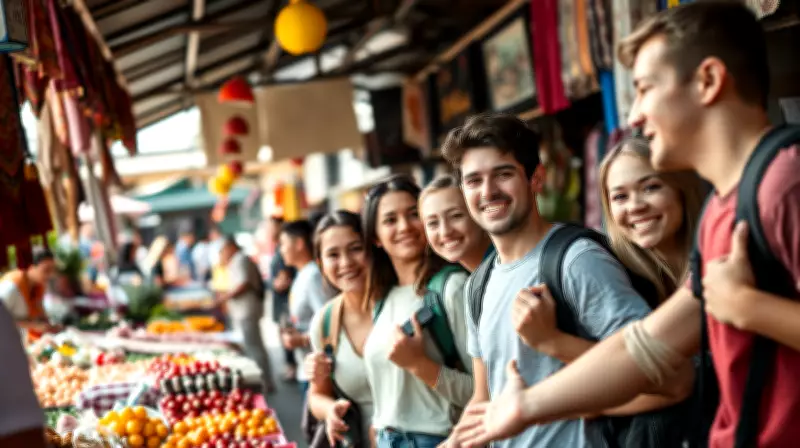
The broader lesson from psychology is simple. Happiness during travel appears to come less from exclusivity and expense and more from immersion, anticipation, discovery, and connection. A budget traveler wandering through a bustling market, sharing a meal with strangers, or navigating an unfamiliar city may be gaining precisely the kinds of experiences that psychological science associates with enduring well-being. Sometimes the memories that stay with us the longest are not the ones that cost the most, but those that make us feel the most.