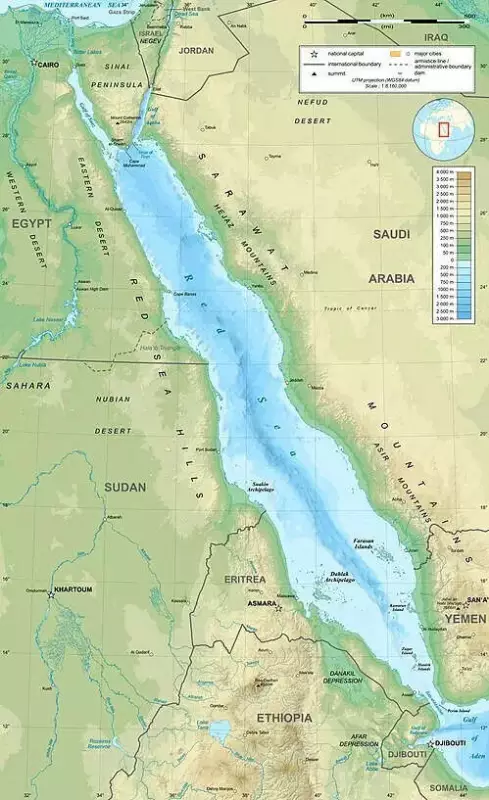
Stretching over 1,200 miles from Egypt's Suez to the Bab el-Mandeb Strait, the Red Sea is a vital aquatic corridor that has shaped global trade for centuries. This narrow but mighty waterway, separating the coasts of Egypt, Sudan, and Eritrea from Saudi Arabia and Yemen, is a unique blend of immense economic importance and breathtaking natural wonders.
The Enigmatic Name: Why is it Called the Red Sea?
The origin of the name 'Red Sea' remains one of its enduring mysteries. The most direct explanation is that it is a translation of its ancient Greek name, Erythra Thalassa. Interestingly, this 'red' reference is primarily found in European languages. In Hebrew, it is known as Yam Suph, or Sea of Reeds, likely named for the papyrus reeds in the Gulf of Suez, while in Egypt it has been called the 'Green Space.'
Scientists offer several compelling theories. One popular explanation points to a seasonal bloom of the cyanobacteria Trichodesmium erythraeum, which can turn the blue-green waters a reddish-brown hue. Another theory is rooted in ancient symbolism, where colours represented cardinal directions. 'Red' often signified the south, and from a Greek or Anatolian perspective, this sea lay to the south, making it the 'Southern Sea.'

A third hypothesis suggests the name comes from the dramatic, iron-rich red mountains and rocky terrain along the coasts, particularly on the western side of the Arabian Peninsula.
A Treasure Trove of Marine Biodiversity
Beyond its name, the Red Sea is an ecological marvel. It is the saltiest sea connected to any ocean, partly because not a single river flows into it. This unique environment has fostered incredible biodiversity.
The sea is home to the world's longest coral reef system, running approximately 1,240 miles along its coastline. Some of these corals are ancient giants, estimated to be as old as 7,000 years. This reef structure is built by over 346 species of hard corals and provides a habitat for an astonishing array of life.
The Red Sea's waters teem with more than 1,166 species of fish, of which about 165 are found nowhere else on Earth. Its vibrant ecosystem also supports around 44 species of sharks and is the habitat for the sailfish, the fastest fish in the world, capable of speeds up to 68 miles per hour.
A Historical Trade Route and Modern Lifeline
The Red Sea's role in human history is as deep as its waters, which plunge to a maximum depth of 9,974 feet. Ancient Egyptians were navigating these waters as early as 2500 BC in search of southern trade routes. Today, its significance has only magnified.
By connecting to the Mediterranean via the Suez Canal, the Red Sea forms a crucial link in global shipping, carrying countless vessels between Europe and Asia. Its strategic and economic importance cannot be overstated, making it a true crossroads of continents and commerce.
From its mysterious nomenclature and ancient exploration trails to its vibrant coral cities and status as a modern economic artery, the Red Sea stands as a remarkable testament to where natural history and human endeavour powerfully intersect.