

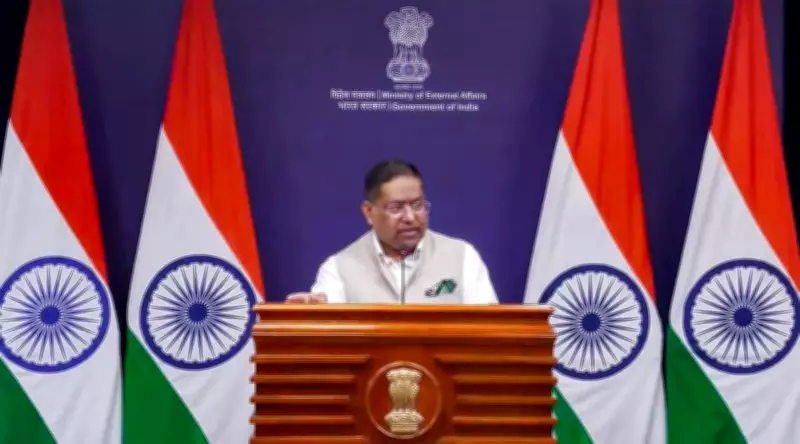
India on Tuesday moved to defuse a diplomatic row with Bangladesh over the return of a senior Bangladeshi adviser from New Delhi earlier this month, clarifying that he had been permitted entry into the country and had subsequently decided to fly back to Dhaka of his own accord.
MEA clarifies sequence of events
Responding to questions on the controversy, the Ministry of External Affairs (MEA) stated that the Bangladeshi official traveled to India on a private passport to attend a multilateral meeting and was allowed entry after routine checks at the airport.
“Advisor to the Prime Minister of Bangladesh arrived in India on 14 June 2026 on a private passport holding a SAARC visa, to attend the 28th Meeting of the Committee of Senior Officials of the Indian Ocean Rim Association (IORA),” MEA spokesperson Randhir Jaiswal said.

“He was queried by immigration officials at Delhi airport and was subsequently permitted entry after re-confirming that the purpose of his visit was to attend the said multilateral meeting. He, however, chose to return to Dhaka of his own volition,” Jaiswal added.
Bangladesh had lodged a formal protest
The clarification came days after Bangladesh formally lodged a protest with India over the incident involving Jahed Ur Rahman, an adviser to the Prime Minister of Bangladesh. According to reports from Dhaka, Rahman was subjected to nearly two-and-a-half hours of questioning at Indira Gandhi International Airport after his name reportedly triggered an alert during routine screening procedures. Although Indian authorities eventually cleared him to proceed, the Bangladeshi official decided not to continue with his visit and returned home.
Bangladesh’s Foreign Minister Khalilur Rahman described the episode as “unexpected and regrettable,” while the country’s Ministry of Foreign Affairs summoned India’s Deputy High Commissioner in Dhaka, Pawan Badhe, to convey its concerns.
Wider context of bilateral ties
The diplomatic friction emerged at a time when both countries have publicly underlined the importance of maintaining close and constructive ties despite occasional irritants. The episode also coincided with a transition at the Indian High Commission in Dhaka, where High Commissioner-designate Dinesh Trivedi recently arrived to succeed Pranay Verma.
The two countries have repeatedly expressed their desire to strengthen cooperation in areas ranging from trade and connectivity to energy and security, making the brief diplomatic spat an unwelcome distraction in an otherwise expanding relationship.






