

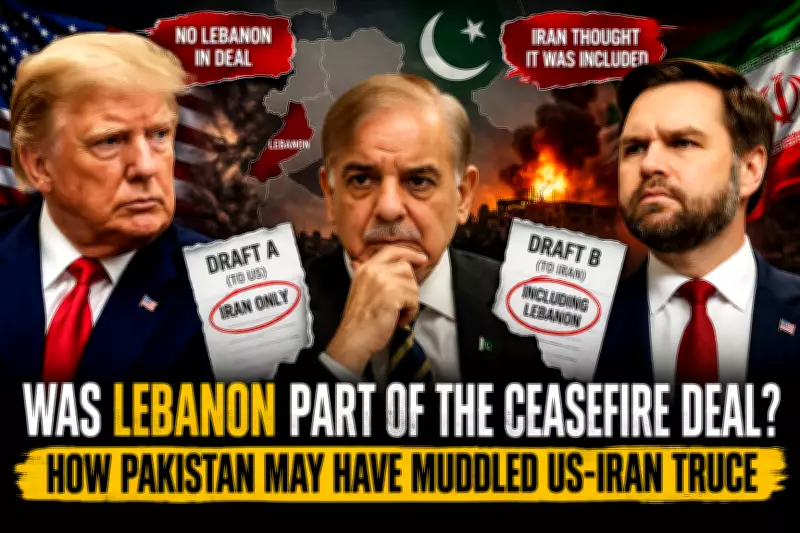
Ceasefire Confusion: US-Iran Truce in Doubt as Pakistan, Washington Clash Over Scope
Less than 24 hours after a ceasefire between the United States and Iran was announced, confusion and conflicting claims over its scope have cast serious doubt on the agreement. Pakistan's role as a mediator has emerged at the centre of this controversy, with stark divergences in public statements threatening to undermine the fragile truce.
Divergent Interpretations Fuel Uncertainty
While Washington has maintained that the truce is limited to Iran and does not extend to other conflict zones, Pakistan publicly announced a broader ceasefire that included Lebanon and other theatres. This position has been echoed by signals from Tehran, raising the possibility that different versions of the ceasefire draft may have been communicated to the two sides.
The lack of a single, clearly defined framework has created significant uncertainty at a critical moment, just as diplomatic efforts were expected to stabilise tensions in the region. The confusion has taken on immediate operational significance, with Israel continuing strikes on Hezbollah targets in Lebanon.

These developments threaten to undermine the fragile truce, as Iran has indicated that attacks on its regional allies could impact its commitment to the ceasefire. With multiple stakeholders working off differing assumptions, the episode has exposed the risks of a loosely structured agreement and raised fresh questions over whether the truce can hold.
Vance Rejects Lebanon's Inclusion, Says Ceasefire 'Focused on Iran'
US Vice President JD Vance firmly rejected claims that Lebanon was part of the ceasefire agreement, asserting that any such interpretation by Iran was incorrect and not part of what Washington had agreed to.
"I think the Iranians thought that the cease-fire included Lebanon, and it just didn't," Vance said. "We never made that promise. We never indicated that was going to be the case. What we said is that the cease-fire would be focused on Iran and the cease-fire would be focused on America's allies."
Vance also echoed the position of White House officials who have said that Iran's publicly released 10-point framework does not align with what has been discussed privately with US negotiators, dismissing Tehran's stated demands in blunt terms. He described them as "little more than a random yahoo in Iran submitting it to public access television."
He further cautioned that Iran risked collapsing the negotiations over an issue that Washington does not consider part of the agreement. "If Iran wants to let this negotiation fall apart, in a conflict where they were getting hammered, over Lebanon, which has nothing to do with them, and which the United States never once said was part of the cease-fire, that's ultimately their choice. We think that would be dumb, but that's their choice."
Downplaying ongoing Israeli military action in Lebanon, Vance maintained that such strikes were unrelated to the ceasefire framework, reiterating that they had "nothing to do with" Iran.
Pakistan's Announcement Contradicts US Position
The confusion appears to stem from Pakistan's role as a mediator. Prime Minister Shehbaz Sharif had publicly stated that the ceasefire covered a wider geography.
"With the greatest humility, I am pleased to announce that the Islamic Republic of Iran and the United States of America, along with their allies, have agreed to an immediate ceasefire everywhere including Lebanon and elsewhere, EFFECTIVE IMMEDIATELY. I warmly welcome the sagacious gesture and extend deepest gratitude to the leadership of both the countries and invite their delegations to Islamabad on Friday, 10th April 2026, to further negotiate for a conclusive agreement to settle all disputes."
In a separate post, Sharif also appealed for a temporary pause in hostilities and reopening of the Strait of Hormuz, tagging key global leaders.

"Diplomatic efforts for peaceful settlement of the ongoing war in the Middle East are progressing steadily, strongly and powerfully with the potential to lead to substantive results in near future. To allow diplomacy to run its course, I earnestly request President Trump to extend the deadline for two weeks. Pakistan, in all sincerity, requests the Iranian brothers to open Strait of Hormuz for a corresponding period of two weeks as a goodwill gesture. We also urge all warring parties to observe a ceasefire everywhere for two weeks to allow diplomacy to achieve conclusive termination of war, in the interest of long-term peace and stability in the region," he wrote.
These statements appeared to contradict Washington's narrower interpretation, fuelling speculation that different versions of the ceasefire draft may have been communicated.
Iran Insists Broader Ceasefire, Signals Pressure Over Hezbollah
Iran, for its part, indicated that it viewed the ceasefire as extending beyond its own territory, including theatres such as Lebanon. Tehran signalled that continued Israeli strikes on Hezbollah could jeopardise the agreement.
"Once again you have shown that you do not understand the concept of a cease-fire, and only fire will bring you to your senses. So you must wait for it," said Ebrahim Azizi, the head of Iran's parliamentary national security committee.
Iran's stance reflects its strategic interest in protecting Hezbollah, a key ally within its regional "axis of resistance". Analysts warned that excluding Lebanon from the deal could undermine Iran's willingness to hold fire.
Trump's 'Real Agreement' Adds to Uncertainty
US President Donald Trump further complicated the already fragile ceasefire narrative by introducing his own version of what he called a "REAL AGREEMENT", creating additional ambiguity over what exactly Washington and Tehran have agreed upon.
In a series of posts and statements, Trump made it clear that the United States does not recognise multiple frameworks under discussion and would only proceed on terms defined by Washington. He asserted that the core of any acceptable deal would revolve around two non-negotiable conditions: "NO NUCLEAR WEAPONS and, the Strait of Hormuz WILL BE OPEN & SAFE."
His remarks came even as differing versions of ceasefire terms and negotiation frameworks continued to circulate, including Iran's previously floated proposals that included provisions on uranium enrichment and broader regional de-escalation. The US administration, however, has rejected such formulations, calling them inconsistent with private communications between negotiators.
Trump's messaging also appeared to shift over the course of hours, first indicating openness to negotiations and then warning of severe consequences if talks fail. "If for any reason it is not, which is highly unlikely, then the 'Shootin' Starts,' bigger, and better, and stronger than anyone has ever seen before," he said, underlining the high-stakes nature of the ongoing standoff.
The insistence on a singular US-defined framework, combined with public dismissal of alternative proposals, has added to confusion among stakeholders and raised questions about whether both sides are negotiating on the same set of terms. With multiple drafts in circulation and no unified text acknowledged by all parties, Trump's "REAL AGREEMENT" stance has emerged as a key factor contributing to the uncertainty surrounding the ceasefire.
Multiple Drafts, Mixed Signals Deepen Truce Uncertainty
Reports indicate that multiple versions of ceasefire proposals, including competing 10-point plans, have circulated between the US and Iran, with discrepancies over key provisions such as uranium enrichment, sanctions relief, and regional scope.
Some Iranian proposals reportedly included halting hostilities in Lebanon, Iraq and Yemen, while US messaging remained focused narrowly on Iran and maritime security, particularly the Strait of Hormuz.
The lack of clarity has been compounded by continued military activity, including Israeli strikes in Lebanon and reported incidents inside Iran, raising questions about whether the ceasefire is holding in practice.
Fragile Peace Hinges on Clarity Ahead of Talks
With talks expected in Islamabad, the success of the ceasefire now depends on reconciling these conflicting interpretations. Even as diplomatic efforts intensify, the disagreement over Lebanon has emerged as a critical faultline.
Whether the truce holds or unravels may depend on how quickly the US, Iran and mediators align on a single, clear framework for de-escalation.





