

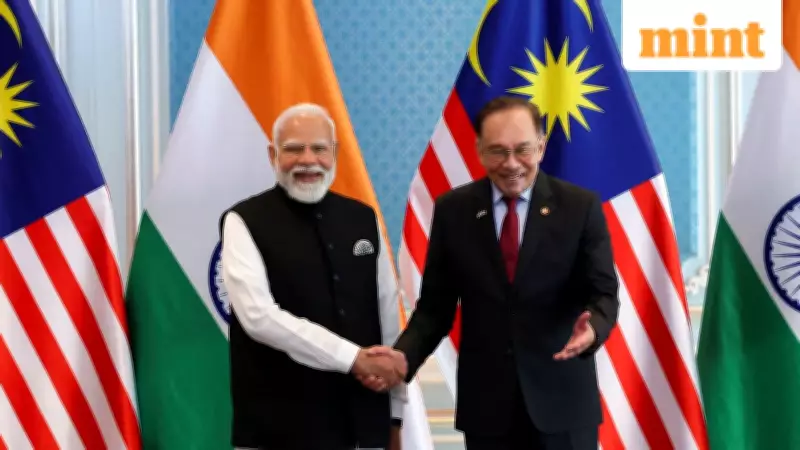
India and Malaysia Announce Major Strategic Partnership Expansion
In a significant diplomatic development, India and Malaysia unveiled a comprehensive series of initiatives on Sunday aimed at substantially strengthening bilateral cooperation across multiple critical sectors. The announcements followed extensive and wide-ranging talks between Prime Minister Narendra Modi and his Malaysian counterpart, Prime Minister Anwar Ibrahim, in Kuala Lumpur.
Reaffirming a Special and Historic Relationship
Addressing the media after the high-level meeting, Prime Minister Modi emphasized the deep and enduring nature of the India-Malaysia bond. "India and Malaysia share a special relationship. We are maritime neighbours. For centuries, our people have had deep and affectionate ties," Modi stated. He highlighted that Malaysia is home to the world's second-largest population of Indian origin, a testament to the profound historical and cultural connections between the two nations.
Modi further noted that shared democratic values and a rich, intertwined cultural heritage continue to serve as powerful unifying forces, binding the two countries together in a partnership that extends far beyond mere diplomatic formalities.

Enhanced Defence and Security Collaboration
A cornerstone of the new agreements is a decisive upgrade in defence and security cooperation. Prime Minister Modi declared that both nations are committed to making their defence partnership "more comprehensive." This will involve intensified collaboration in several key areas:
- Counter-Terrorism: A firm and unified stance against terrorism, with Modi unequivocally stating, "Our message on terrorism is clear; no double standards, no compromise."
- Intelligence Sharing: Establishing more robust mechanisms for the exchange of critical security intelligence.
- Maritime Security: Strengthening cooperation to ensure safety and stability in the shared maritime domain, a vital interest for both maritime neighbours.
Advancing Technological and Economic Partnerships
Looking to the future, the leaders charted an ambitious course for collaboration in cutting-edge technology and vital economic sectors. "Along with AI and digital technologies, we will advance partnerships in semiconductors, health, and food security," Prime Minister Modi announced. This signals a strategic pivot towards building resilient supply chains and fostering innovation-driven growth, with semiconductors being a particularly critical area of focus in the global tech landscape.
Echoing this sentiment, Malaysian Prime Minister Anwar Ibrahim affirmed that India and Malaysia continue to actively expand their collaboration in trade, investment, and connectivity. He praised India's "spectacular rise" on the global trade and economic front, recognizing it as a dynamic partner for Malaysia's own growth ambitions.
A Shared Vision for the Indo-Pacific
The discussions also encompassed broader regional geopolitics, with a focus on the Indo-Pacific. Prime Minister Modi described the region as "the growth engine of the world" and reiterated India's steadfast commitment to fostering development, peace, and stability across the entire Indo-Pacific region. This commitment is framed in close partnership with ASEAN, of which Malaysia is a key member, underscoring a multilateral approach to regional security and prosperity.
A Ceremonial Welcome Signals Renewed Momentum
The substantive talks were preceded by a grand ceremonial welcome for Prime Minister Modi, who arrived in Kuala Lumpur on Saturday. He was received at the airport by Prime Minister Anwar Ibrahim with a red-carpet reception, a gesture symbolizing the warmth and high priority accorded to the visit. On Sunday morning, Modi was formally accorded a ceremonial guard of honour at Perdana Putra, the Malaysian Prime Minister's office complex, setting a positive and respectful tone for the day's crucial negotiations.
This high-profile visit and the subsequent agreements mark a clear and purposeful step towards injecting new momentum into the India-Malaysia bilateral relationship, positioning it as a key strategic partnership in Asia with significant implications for regional stability and economic integration.






