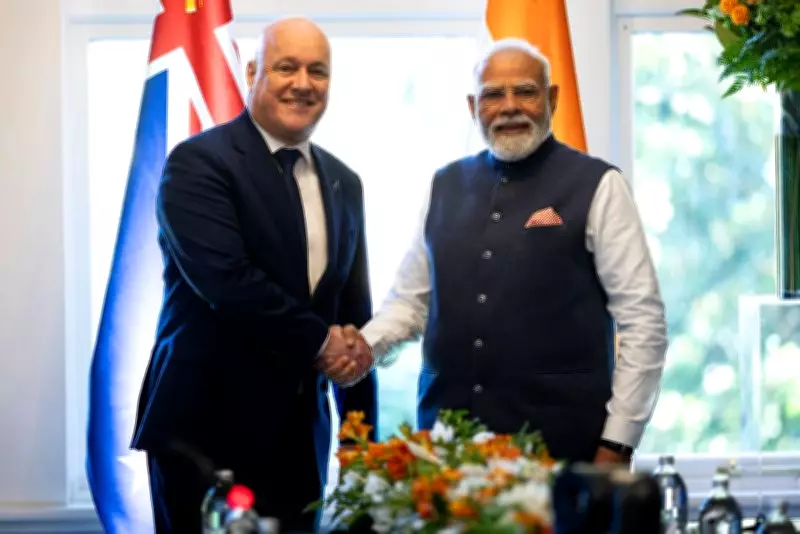
India and New Zealand on Saturday elevated their bilateral relationship to a strategic partnership, setting an ambitious five-year target to double annual two-way trade in goods and services to 7 billion New Zealand dollars, approximately Rs 35,000 crore, by 2030. The announcement followed talks between Prime Minister Narendra Modi and his New Zealand counterpart Christopher Luxon in Auckland.
18 concrete outcomes and 10 agreements
The meeting yielded 18 concrete outcomes, including 10 formal agreements. Key deliverables include a roadmap to expand ties over the next four years, a framework for enhancing Indo-Pacific maritime cooperation, and a reciprocal logistics support pact between the Indian Navy and the New Zealand Defence Force. “We have decided to elevate our ties to a Strategic Partnership. We will move forward across every sector with clear goals and concrete outcomes,” Modi said after the talks.
Shared vision for Indo-Pacific
A joint statement noted that Modi and Luxon exchanged views on the Indo-Pacific, reaffirming their shared commitment to a free, open, and prosperous region. They emphasised the importance of safeguarding sovereignty, territorial integrity, and the rules-based international order. The two prime ministers called for freedom of navigation and overflight, and other lawful uses of the seas, in accordance with international law, particularly the 1982 United Nations Convention on the Law of the Sea.

In line with their focus on boosting cooperation in the Indo-Pacific, the two sides agreed to establish a maritime security dialogue to strengthen cooperation, coordination, and information exchange. Modi landed in Auckland on Friday night in the third and final leg of his three-nation tour, which largely focused on expanding cooperation in the Indo-Pacific against the backdrop of China's increasing assertiveness in the region. The visit came following the recent signing of the India-New Zealand Free Trade Agreement (FTA).
Maritime nations strengthening Indo-Pacific
In his remarks at the talks, Modi said deeper cooperation between India and New Zealand, both maritime nations, will inject new strength into the Indo-Pacific. “As two maritime nations, our close cooperation lends new strength to the Indo-Pacific, and our ties can infuse fresh energy into achieving our shared goals of peace,” the prime minister said in Hindi.
The two prime ministers agreed to work towards an aspirational goal of doubling bilateral two-way trade in goods and services to 7 billion New Zealand dollars (approximately Rs 35,000 crore) by 2030. They also resolved to work together to ensure the early entry into force of the FTA.
West Asia and Ukraine conflicts
Modi and Luxon, delving into the West Asia conflict, expressed concern over renewed escalation of tensions and called upon all parties to exercise restraint, de-escalate tensions, and ensure protection of civilians, the joint statement said. “They called for full restoration of freedom of navigation and the global flow of commerce through the Strait of Hormuz, while opposing any constraints on shipping,” it said. The two leaders reiterated the importance of dialogue and diplomacy, and adherence to international law to achieve a peaceful and lasting solution to the conflict.
On Ukraine, Modi and Luxon expressed concern over the ongoing war, which continues to “cause immense human suffering and global consequences,” according to the statement.
UN reform and counter-terrorism
Modi and Luxon also pitched for “bold and effective” reform of the United Nations and affirmed their support for expansion of the Security Council. The two leaders also discussed the importance of stable, transparent, and resilient supply chains and recognised the “important role” that India is playing in strengthening resilience across global energy networks. “They expressed deep concern about the impacts of disruptions across the Indo Pacific, noting that the stability of global supply routes is essential to the region,” the joint statement said. The two sides especially noted that this is particularly acute for Pacific Island countries, where economies are heavily exposed and higher oil prices are driving increases in costs of electricity generation, shipping, transportation, agriculture, and fisheries.

Both leaders reiterated their condemnation of terrorism in all its forms, including cross-border terrorism. They condemned in the strongest terms the terrorist attack in Pahalgam and the terror incident near Red Fort last year and stressed that those responsible for the attacks should be held accountable. They called for a “zero-tolerance” approach to terrorism, and underlined the need for disrupting terror financing networks and safe havens.