

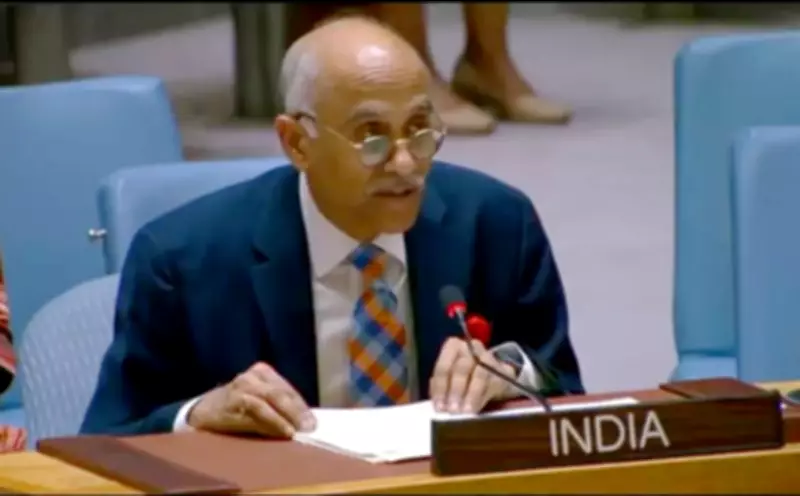
India has condemned efforts by certain nations to undermine the credibility of the Financial Action Task Force (FATF), stating that such actions reveal a "fear of scrutiny." In a thinly veiled reference to Pakistan, India urged these countries to cease exporting instability and prevent their territory from being exploited for terrorist activities.
India's Permanent Representative to the United Nations, Parvathaneni Harish, delivered these remarks on Monday during a side event of the 2026 Counter-Terrorism Week, titled 'Joining Forces to Counter Terrorism Financing in the Context of Evolving Threats and Emerging Technologies.' The event was co-organized by the Permanent Missions of India and France, along with the Counter-Terrorism Committee Executive Directorate, the United Nations Office of Counter-Terrorism, and the Global Internet Forum to Counter Terrorism.
FATF as an Indispensable Pillar
Harish emphasized that the FATF remains a cornerstone of the global framework for combating terrorist financing and money laundering. "The FATF remains an indispensable pillar of the global counterterrorism financing and anti-money laundering architecture. Its work is technical, evidence-based and rooted in internationally accepted standards. Attempts to question its credibility often reflect fear of scrutiny rather than genuine process-related concerns," he stated.

He called on countries facing adverse FATF assessments to address identified deficiencies, strengthen domestic enforcement, improve financial transparency, and demonstrate irreversible action against terror-financing networks. "The answer to FATF scrutiny is not politicised activism in UN forums but credible compliance. States that allow their territory, institutions or financial channels to be misused for terrorism must stop exporting instability and start fulfilling their obligations towards international peace and security," Harish added, in a clear allusion to Pakistan, which was on the FATF grey list from 2018 to 2022.
India's Experience with Cross-Border Terrorism
Harish noted that India has faced cross-border terrorism for decades, and emerging digital technologies have further complicated the sources, methods, and channels used for asset flows. "For decades now, my country, India, has confronted cross-border terrorism, and new digital technologies are only making the sources, the methods, and channels used for the flow of assets more complex," he said.
India has been a member of the FATF since 2010. Earlier this month, Union Culture Secretary Vivek Aggarwal was appointed Vice-President of the FATF for the period July 2026 to June 2027.
Emerging Technologies and Terrorist Financing
Harish highlighted that crowdfunding platforms and prepaid instruments have become central to the funding infrastructure of global terrorist operations. "Crowdfunding from radicalised individuals for terrorist financing and use of tokens, stars and points in social media platforms by terrorists to store and transfer their value are real issues of deep concern for all of us," he warned.
He stressed that terrorists are technology neutral, adopting whatever is cheap, fast, and lightly regulated. "Our response must be a risk-based architecture anchored in the FATF standards," he said, adding that critical terrorist financing risks have historically not emerged anonymously but have been sponsored, including by some state actors—again referencing Pakistan.
Regulation Must Not Punish the Legitimate
Harish argued that regulation should not penalize legitimate activities. "Steps towards financial inclusion, humanitarian action and responsible innovation are only undermined when illicit flows go unchecked. Therefore, the regulatory outcome should be proportional, not prohibitive," he said. India has made an "honest effort" to practice what it advocates by bringing virtual asset service providers within its anti-money laundering framework, tightening verification requirements for centralized exchanges and users, and contributing case studies to FATF updates on mitigating terror financing risks.

India's Leadership in Counter-Terrorism
In October 2022, the Security Council Counter-Terrorism Committee, chaired by India that year, organized a special meeting in New Delhi and Mumbai on countering the use of new and emerging technologies for terrorist purposes. The committee adopted the 'Delhi Declaration' as an outcome. Harish noted that India focused the committee's attention on virtual assets and online platforms, and as head of the UNSC CTC, India developed non-binding guiding principles pursuant to the Delhi Declaration. "It is a matter of great satisfaction that its pillars are being taken forward and the world is gaining from it," he said.
UN Secretary-General's Remarks
UN Secretary-General Antonio Guterres, addressing the Fourth High-Level Conference on Counter-Terrorism, highlighted that the world is grappling with acute instability, with conflicts triggering energy shocks, inflation, and hunger. "These conditions—of want, of fragility, of mistrust—are ideal circumstances for terror to thrive. From Africa to South Asia, and across the Middle East, affiliates of Al-Qaida and Da'esh and other terrorist groups persist," he said.
Guterres noted that violent extremist narratives, including those based on xenophobia, racism, and other forms of intolerance or in the name of religion or belief, pose deadly domestic threats. "Terrorists of all stripes are adapting. New technologies make it easier for them to finance and recruit. Criminal networks speed the flow of cash and weapons, now including deadly drones," he added. He called for international cooperation to address the conditions that allow terrorism to take root, emphasizing that no nation can address this transnational threat alone.





