

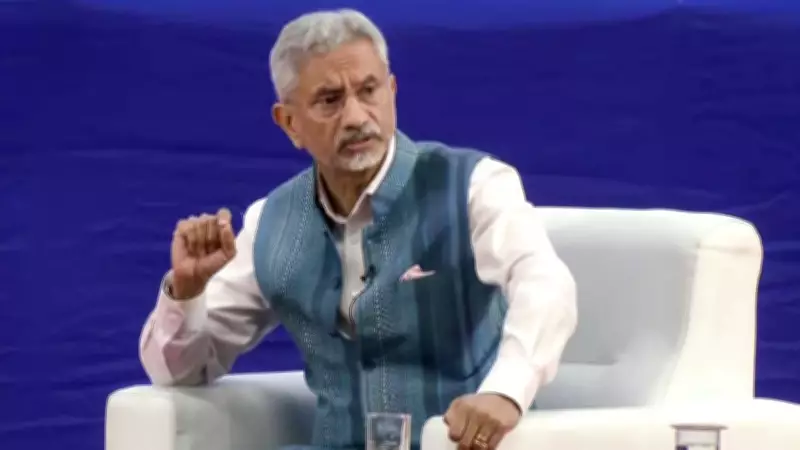
External Affairs Minister S. Jaishankar is currently in Washington DC for a pivotal meeting with US Secretary of State Marco Rubio, marking their first engagement since the announcement of a trade pact between India and the United States. This high-stakes dialogue comes at a critical juncture, as India faces dual challenges: navigating the potential stoppage of Russian oil imports and striving to meet an ambitious $500 billion trade target. Officials indicate that India's responses will be shaped by its core priorities of energy security and national security needs.
Navigating the Russian Oil Conundrum
US President Donald Trump recently claimed in a social media post that Prime Minister Narendra Modi has agreed to halt purchases of Russian oil and increase imports from the United States and potentially Venezuela, framing this as a move to help end the war in Ukraine. Prime Minister Modi has not publicly responded to this assertion, and sources in Delhi suggest the government may avoid directly contradicting the US President, unlike previous instances where it corrected similar claims.
India has consistently maintained that its oil import decisions are driven by market realities, a stance it has upheld since Russia's invasion of Ukraine in February 2022. During this period, India capitalized on discounted Russian oil as an economic strategy, which drew criticism from European nations, particularly those bordering Russia, and Ukrainian officials. However, the United States and Western Europe largely tolerated this arrangement as India adhered to price caps and maintained demand-supply equilibrium under the Biden administration.

Shifting Dynamics Under the Trump Administration
The landscape has shifted under President Trump, who imposed a 25% tariff penalty on Indian purchases of Russian oil. In response, India has engaged in high-level discussions with Russian President Vladimir Putin, including meetings in Tianjin and Delhi, to address these new challenges. The Kremlin has downplayed Trump's announcement, noting that no official statement has been issued by New Delhi on the matter.
Historically, India has not publicly confirmed halts on oil imports from countries like Iran or Venezuela under US pressure, and it is likely to follow a similar approach with Russia. Sources reveal that the government will prioritize national interests, potentially compensating for any supply gaps by sourcing energy from alternative providers such as the United States and Venezuela, a move Trump would likely view favorably.
Achieving the $500 Billion Trade Target
Beyond energy, India faces the challenge of boosting trade with the United States to reach a $500 billion target by 2030, a goal set during Prime Minister Modi's visit to the US in February 2025 under the "Mission 500" initiative. This vision aims to more than double bilateral trade, but achieving it requires more than just agricultural products like corn, as currently discussed by US officials.
The details of tariff reductions and commodity baskets remain undisclosed, but experts suggest that significant progress will hinge on India's procurement of US defence equipment and aircraft, both civilian and military. This aligns with India's national security interests and could be a key driver in meeting the trade target, reflecting a strategic partnership that extends beyond mere economic transactions.
In summary, as External Affairs Minister Jaishankar engages in crucial talks in Washington, India's approach to the Russian oil issue and the $500 billion trade ambition will be meticulously crafted to safeguard its energy and national security, balancing diplomatic relations with pragmatic economic policies.






