EU's Kallas Delivers Blunt Rebuke to Trump Envoy at Munich Security Conference
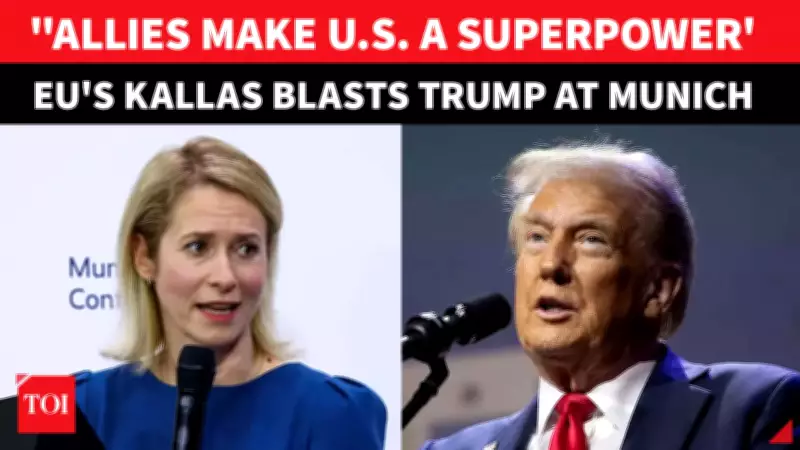
In a tense exchange at the high-profile Munich Security Conference, European Union foreign policy chief Kaja Kallas issued a sharp rebuttal to Trump administration UN envoy Mike Waltz. The confrontation highlighted deep-seated tensions over perceptions of global security burdens and alliances.
Kallas Challenges Claims of American Isolation
Pushing back against assertions that the United States bears the global security load in isolation, Kallas firmly declared, "Russia fights alone, America doesn't." This statement served as a powerful reminder of Europe's historical and ongoing collective support for American military engagements.
She underscored that Europe has consistently backed the U.S. in major conflicts, citing examples from the Iraq War to the prolonged campaign in Afghanistan. This emphasis aimed to counter narratives that portray America as a solitary actor on the world stage, instead framing it as part of a broader transatlantic partnership.

Context of the Munich Security Conference Clash
The Munich Security Conference, a premier gathering for international security discussions, provided the backdrop for this diplomatic friction. The event, held on February 14, 2026, brought together key global leaders and policymakers, with this particular session focusing on the dynamics of international cooperation and burden-sharing.
Kallas's remarks were directed at Waltz, who has been a vocal proponent of the view that the U.S. disproportionately shoulders global responsibilities. Her response not only defended European contributions but also subtly critiqued the Trump administration's approach to alliances, suggesting a need for greater acknowledgment of collaborative efforts.
Implications for EU-US Relations and Global Security
This exchange underscores ongoing strains in EU-US relations, particularly regarding defense and foreign policy coordination. By highlighting Europe's role in past conflicts, Kallas reinforced the importance of mutual recognition and solidarity within the transatlantic alliance.
The incident also reflects broader geopolitical tensions, with Russia's actions serving as a contrasting example of unilateralism. Kallas's pointed comparison between Russia and America aimed to reaffirm the value of collective security frameworks over go-it-alone strategies.
As global security challenges evolve, such dialogues at forums like the Munich Security Conference are crucial for shaping future policies and reinforcing international partnerships against common threats.