

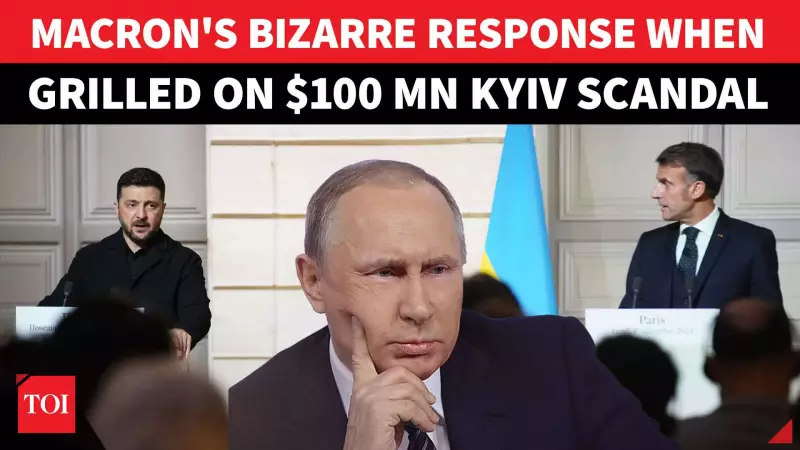
French President Emmanuel Macron has adopted a distinctive position regarding the recent corruption scandal in Ukraine, choosing to deflect criticism towards Moscow instead of Kyiv. Speaking in Paris, Macron clarified that France has no plans to lecture Ukrainian leadership, acknowledging that corruption exists in all democracies.
Macron's Defence of Ukraine and Democratic Scrutiny
Addressing the issue on December 1, 2025, Macron argued that the presence of corruption scandals is a reality in every democratic nation, including his own country, France. The crucial distinction, according to the French leader, lies in how such issues are handled. He emphasized that accountability and transparency are what separate democracies from other systems.
Macron's comments come at a time when Europe is significantly financing Kyiv's war effort against the Russian invasion. He stated that while financial scrutiny is necessary, the ongoing reminders about the need for transparency and justice in Ukraine should not be viewed in isolation.

The Sharp Critique of Russia's 'Opaque System'
The French President saved his most pointed criticism for Russia. He labelled the nation under Vladimir Putin as "the real dictatorship". Macron's argument centred on the nature of corruption in Russia, where he claims it goes unaddressed, unseen, and unquestioned by any independent institutions or public scrutiny.
This direct comparison serves to redirect the narrative surrounding the $100 million scandal involving Ukrainian officials. Macron suggested that the systemic, opaque corruption within the Kremlin's sphere poses a far greater threat to sovereignty and justice than the exposed scandals in a democracy like Ukraine.
Broader Implications for European Support
Macron's stance carries significant weight as it reinforces the political rationale behind continued European support for Ukraine. By framing the issue as a contrast between a flawed but accountable democracy and an opaque dictatorship, he aims to solidify Western backing.
The message is clear: the challenges of governance in Ukraine, while requiring vigilance, are part of a democratic process. In contrast, the lack of such a process in Russia defines its authoritarian character. This perspective is likely intended to bolster unity among allies as the conflict continues.






