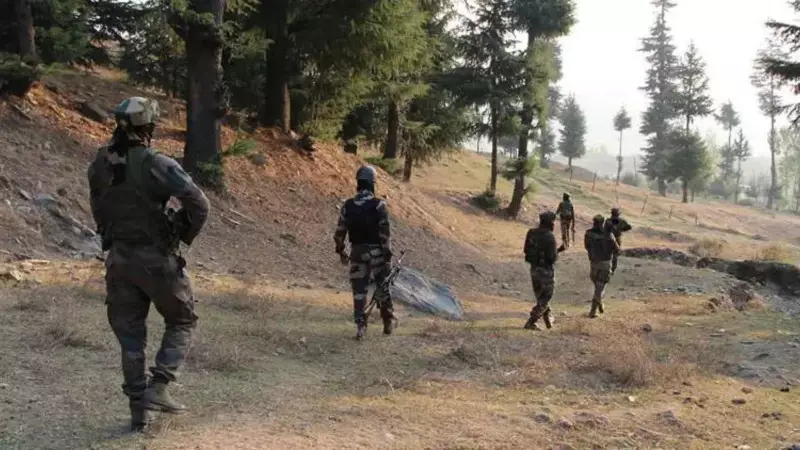
In a significant security update, the Border Security Force (BSF) has disclosed that Pakistan has reconstructed and reactivated a network of 72 terror launch pads along the sensitive Jammu frontier. This development comes nearly seven months after India's decisive military action, Operation Sindoor, inflicted extensive damage on Pakistani border posts and terrorist infrastructure.
Post-Operation Sindoor: A Shift in Pakistani Tactics
BSF Deputy Inspector General (DIG) Vikram Kunwar, addressing a press conference on Saturday, outlined Pakistan's evolving strategy. He stated that following the heavy blows sustained during Operation Sindoor in May 2025, Pakistan initially adopted a policy of relocating terror launch pads from immediate border areas to depth locations. However, this shift appears to be incomplete.
"Old habits die hard," DIG Kunwar remarked, revealing that a dozen terror launch pads have become active again near the International Border (IB) in Pakistan's Sialkot and Zafarwal sectors. Furthermore, an additional 60 launch pads have been reactivated in areas across the Line of Control (LoC) near Jammu. The officer noted that while terrorist numbers fluctuate, they are typically housed in small groups of two to three individuals.

Scale of Damage from Operation Sindoor and Current Vigilance
Detailing the impact of the previous operation, DIG Kunwar confirmed that a total of 118 Pakistani posts were extensively damaged during Operation Sindoor. This included 72 posts along the International Border in Hiranagar, Samba, and Jammu, and 46 along the LoC in Rajouri and Poonch. Their surveillance systems were also destroyed.
BSF Inspector General Shashank Anand added that the Pakistani Rangers, who had abandoned their posts during the operation, have since returned. "We are keeping a watch on all activity and the installations of our counterpart across the border," he asserted. He emphasized the force's enhanced technological vigilance, employing ground surveillance radars, electro-optical thermals, and Unmanned Aerial Vehicles (UAVs) to secure the borders.
Countering the Evolving Drone Threat and Future Warfare
Highlighting a modern challenge, IG Anand pointed out that drones have emerged as a persistent threat since 2019. In response, the BSF has not only trained its troops but has also deployed counter-drone systems. He drew parallels to contemporary global conflicts, stating that 21st-century warfare, including cross-border engagements, invariably possesses an aerial dimension.
To stay ahead of this curve, the BSF's School of Drone Warfare in Gwalior has entered into a Memorandum of Understanding (MoU) with IIT Delhi and IIT Chennai for collaborative research and development. "We are constantly working on it and we feel that the aerial dimension will always be there in wars in the future," IG Anand concluded.
It is important to note that while there are currently no terrorist training camps directly across the International Border, security agencies maintain reports of such camps operating in depth areas across the Line of Control. Operation Sindoor was launched on the night of May 6-7, 2025, as a direct response to the devastating terror attack in Pahalgam on April 22, 2025, which claimed 26 lives.