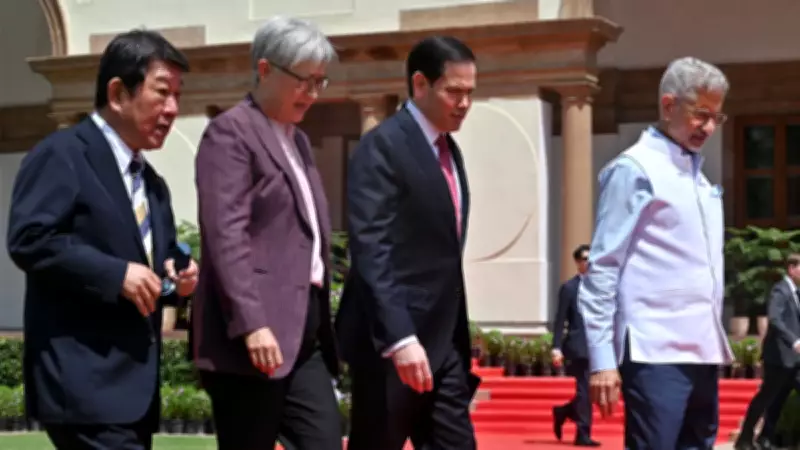
The Quadrilateral Security Dialogue (Quad) has issued a stern warning against acts of coercion and terrorism in the Indo-Pacific region, explicitly condemning the recent terror attack in Pahalgam, Jammu and Kashmir. In a joint statement released after their virtual meeting, the leaders of the United States, India, Japan, and Australia underscored their commitment to a free and open Indo-Pacific, based on the rule of law and respect for territorial integrity.
Strong Condemnation of Pahalgam Attack
The Quad leaders expressed deep condolences for the victims of the Pahalgam attack, which resulted in multiple casualties. They called for the perpetrators to be brought to justice and emphasized that terrorism in all its forms is unacceptable. The statement read, "We condemn in the strongest terms the heinous terrorist attack in Pahalgam. Such acts of violence have no place in the Indo-Pacific, and we stand united against terrorism."
Commitment to Regional Stability
The Quad also reaffirmed its dedication to maintaining peace and stability in the region. The leaders discussed the importance of maritime security, including freedom of navigation and overflight, and the need to resolve disputes through peaceful means. They highlighted the significance of the ASEAN-centered regional architecture and supported the implementation of the ASEAN Outlook on the Indo-Pacific.

Furthermore, the Quad members agreed to enhance cooperation in areas such as cybersecurity, critical technologies, climate change, and pandemic preparedness. They launched new initiatives for infrastructure development, including the Quad Infrastructure Fellowships and the Quad Climate and Clean Energy Partnership.
- Infrastructure Development: The Quad Infrastructure Fellowships aim to train professionals in sustainable infrastructure projects across the Indo-Pacific.
- Climate Action: The Climate and Clean Energy Partnership focuses on accelerating the transition to clean energy and reducing emissions.
- Cybersecurity: Joint exercises and information sharing to counter cyber threats and protect critical infrastructure.
Reactions from Member Nations
Indian Prime Minister Narendra Modi welcomed the Quad's strong stance on terrorism and reiterated India's zero-tolerance policy. He said, "India appreciates the Quad's solidarity on the Pahalgam attack. We are committed to working with our partners to ensure the Indo-Pacific remains a region of peace and prosperity." US President Joe Biden highlighted the importance of democratic values and rule of law, while Japanese Prime Minister Fumio Kishida and Australian Prime Minister Anthony Albanese echoed similar sentiments.
The Quad's statement also addressed concerns about the situation in the South China Sea and the East China Sea, calling for restraint and adherence to international law. The leaders stressed the need for transparency in maritime activities and opposed any unilateral attempts to change the status quo.
Future Engagements
The Quad leaders agreed to hold an in-person summit later this year, with India set to host the next meeting. They also announced the establishment of a Quad Secretariat to coordinate joint initiatives and ensure effective implementation of decisions. The group plans to expand collaboration with other like-minded partners in the region, including Pacific Island nations and Southeast Asian countries.
The Quad's unified message comes at a time of heightened tensions in the Indo-Pacific, with concerns over assertive actions by certain nations. The group's commitment to a rules-based order and its condemnation of terrorism send a clear signal that the international community will not tolerate destabilizing activities.