

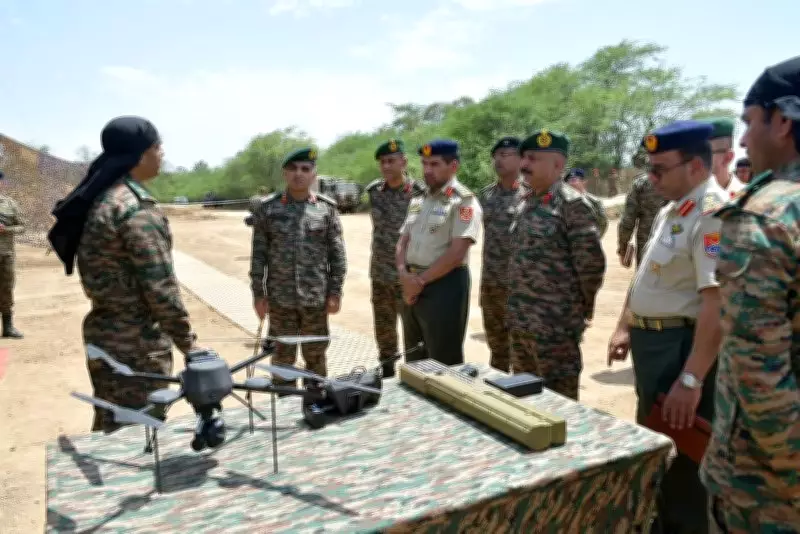
The Indian Army hosted a high-level military delegation from the United Arab Emirates, showcasing its firepower, training capabilities, and advanced technology facilities along the western front. The five-member delegation, led by Brigadier General Staff Mohamed Khamees Al Hassani, Deputy Commander of the UAE Land Force, paid homage at the National War Memorial in New Delhi on Thursday.
Visits to Army Training Establishments
Earlier, the delegation visited the Army War College at Mhow, Madhya Pradesh, and the Infantry School located at the same site. They were briefed on the institutional training imparted at various establishments in Mhow. The Army War College posted on X that it hosted the UAE delegation, with discussions covering contemporary conflicts, multi-domain operations, and avenues for bilateral cooperation in professional military education.
Exposure to Advanced Technology
The delegation received first-hand experience of state-of-the-art AI and quantum lab facilities, modern weapon systems, and tactical training methodologies. This exposure highlighted India's advancements in defence technology and its commitment to sharing expertise with strategic partners.

Mechanised Manoeuvres and Integrated Operations
A day earlier, the delegation visited an Army division tasked with western operations. They witnessed mechanised manoeuvres and integrated operations showcasing the Indian Army's own UAV and counter-UAV capabilities. The Army's South Western Command stated that during interactions, both sides exchanged views on contemporary security challenges, emerging defence technologies, and evolving operational concepts. This reaffirmed the shared commitment of India and the UAE towards strengthening military-to-military cooperation and fostering a robust friendship.
Deepening Defence Ties Since 2023
Sources indicated that India and the UAE have rapidly deepened defence ties since 2023, moving from periodic exercises and equipment cooperation to a formal Strategic Defence Partnership. This expanded cooperation across maritime security, defence industry collaboration, cyber and counter-terrorism, training and interoperability, and intelligence sharing. In January 2026, the two governments signed a Letter of Intent toward a Strategic Defence Partnership, committing to negotiate a framework agreement to deepen and broaden defence cooperation.






