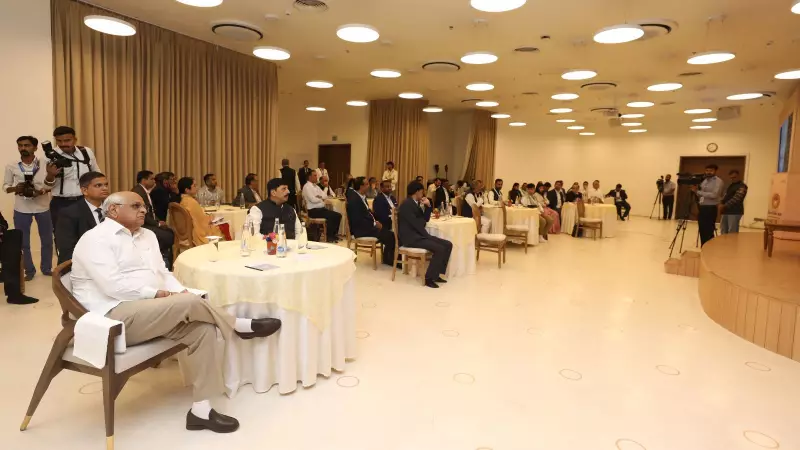
The Gujarat government recently concluded its 12th Chintan Shibir, a high-level brainstorming retreat, with a sharp focus on identifying and strengthening the state's weaker areas while scaling up performance in others. The camp, held from November 27 to 29, gained significance as it followed Ahmedabad's confirmation as the host city for the 2030 Commonwealth Games.
A Strategic Retreat in a Serene Setting
In a departure from the usual venue, Chief Minister Bhupendra Patel, along with his cabinet ministers and senior secretaries, traveled from Gandhinagar to Valsad via the Vande Bharat train. The total delegation comprised 241 participants. The three-day session was organized by the state Administrative Reforms Commission at the Shrimad Rajchandra Mission Ashram in Dharampur, Valsad.
Officials noted that the choice of this spiritual ashram, spread over 223 acres and built on a hillock by Rakeshbhai, was "unusual" but highly effective. The self-contained centre, equipped with modern amenities, provided a calm and serene environment that facilitated more relaxed and focused discussions. Unlike previous greenfield setups, the ready infrastructure allowed participants to concentrate solely on deliberations without worrying about logistical arrangements.

Five Core Areas of Deliberation
The discussions were meticulously planned and structured around five critical themes where Gujarat seeks improvement or major expansion. These areas were:
- Capacity Building and Evaluation
- Nutrition and Health
- Green Energy and Environment
- Public Safety
- Growth in the Service Sector
To ensure productive talks, concept papers and background materials were shared with the five working groups well in advance. Chief Minister Patel set the tone with an inaugural address emphasizing a "way forward, with greater speed and excellence."
Deep Dives into Critical Sectors
The session on service sector growth and diversification involved a thorough review of the current landscape. Participants examined key initiatives across employment, IT and ITES global capacity centres, financial services, manufacturing-linked services, port-operated services, and the gig, care, and green economies. The goal was to formulate future strategies to establish Gujarat as a leader in this sector.
On the public safety front, discussions covered technology integration, transparency, collective responsibility, and creating efficient systems for civil security. The panel looked into roads, bridges, government buildings, water supply, sewage networks, traffic management, fire safety, and emergency services.
The nutrition and public health discussion took a hard look at Gujarat's indicators for maternal and infant mortality, anaemia, and child malnutrition (wasting, underweight, and stunting). The focus was on strengthening infrastructure, ensuring effective scheme delivery to vulnerable groups, and using technology for better outcomes.
Integrating wellness into the schedule, the retreat also included well-planned sessions on meditation and yoga, which officials said contributed to the quality of the outcomes.
A Legacy of Administrative Reform
The Chintan Shibir was initiated in 2003 by the then Chief Minister, now Prime Minister Narendra Modi. Its enduring aim is to make Gujarat's administration more citizen-centric, transparent, and efficient. While most previous editions were held in Kevadia near the Sardar Sarovar Dam, and the last one in Somnath, the Valsad edition was marked by its structured planning and unique, contemplative venue.
Officials concluded that this 12th edition, by moving beyond the capital and into a reflective space, successfully fostered intensive group deliberations aimed at shaping a more robust and competitive future for Gujarat.