

Punjab Power Corporation Reverses Course on Underground Wiring in Ludhiana
In a significant policy reversal, the Punjab State Power Corporation Limited (PSPCL) has decided to abandon its underground power supply system in Ludhiana and return to traditional overhead lines. This move comes after years of operational challenges with the underground network, which was initially implemented in 2011, inspired by models in cities like Ahmedabad and Pune.
Technical Hurdles Prompt Major Shift
PSPCL officials have reported that the underground wiring system, once hailed as a modern solution, has proven to be fraught with difficulties. Tracing faults and conducting repairs became excessively time-consuming, leading to prolonged power outages for residents. The system, operational for several years, faced numerous technical issues that hampered efficient maintenance and timely resolution of problems.
According to department sources, the initial decision to go underground was driven by multiple factors, including the Ferozepur Road eight-lane project, the need to clear unsightly hanging wires from buildings and markets, and a desire to enhance public safety by preventing accidents. Despite these well-intentioned goals, the reality on the ground has been starkly different, with the underground cables resulting in frequent and lengthy disruptions to electricity supply.

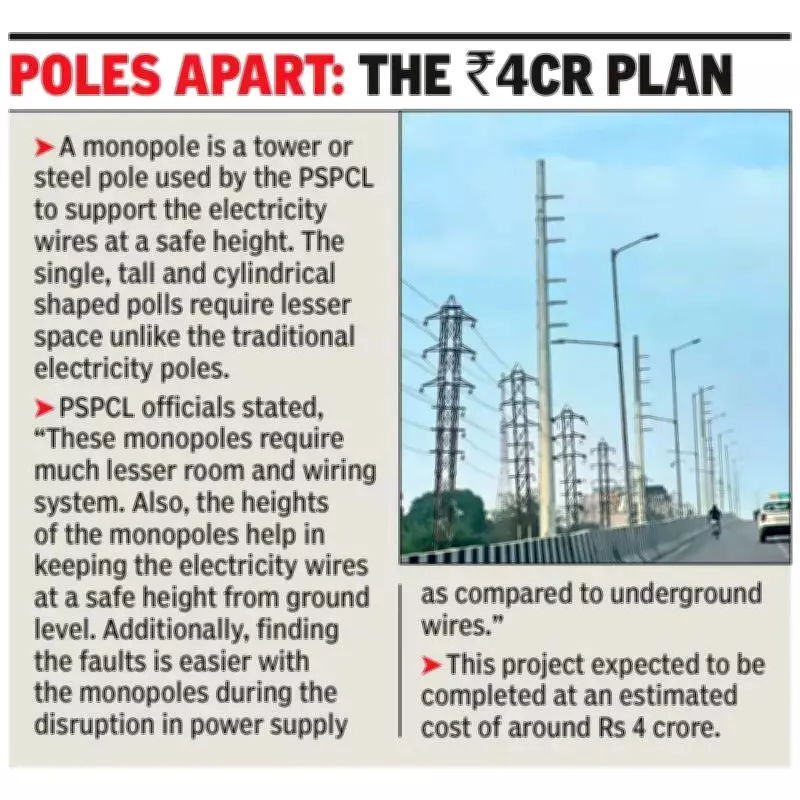
New Project with Monopole Structures Underway
To address these persistent issues, PSPCL is now embarking on a new project to install monopole overhead structures. This transition is scheduled for completion by the end of March, with an estimated budget of approximately 4 crore rupees. The work specifically involves shifting 66KV underground cables from the 220 KV substations located on Ferozepur Road. These substations are critical as they supply power to key areas such as Punjab Agricultural University (PAU), Fountain Chowk, the DC Complex, and Sarabha Nagar.
Jagdev Singh Hans, Chief Engineer of PSPCL Ludhiana, elaborated on the decision, stating, "It was a time-consuming process for officials to trace faults in underground wires and resolve issues promptly. The department received multiple complaints from areas supplied through these cables." He further explained that the new monopole system is designed to mitigate these challenges by offering easier fault detection and requiring less space.
Benefits of the Overhead Return
Hans highlighted several advantages of reverting to overhead lines, particularly as summer approaches. "As summer approaches, residents will not suffer from long power cuts. These monopoles take up less space, and it is much easier to trace supply faults with these poles than with underground wiring," he added. This shift is expected to enhance reliability and reduce downtime, providing a more stable power supply for Ludhiana's residents and businesses.
The move underscores a broader lesson in urban infrastructure management, where technological advancements must be balanced with practical maintenance considerations. PSPCL's experience serves as a cautionary tale for other cities considering similar underground projects, emphasizing the importance of robust fault-tracing mechanisms and efficient repair protocols.






