

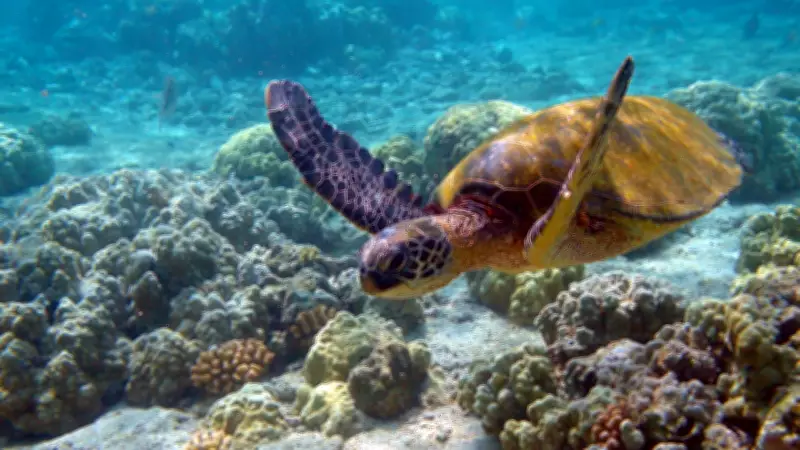
The Union Ministry of Environment, Forest and Climate Change released a Standard Operating Procedure (SOP) on Saturday, establishing a unified and scientifically robust framework for the conservation, monitoring, and management of sea turtles across Lakshadweep.
All four major species of sea turtles found in the region—Green turtles, Hawksbills, Leatherbacks, and Olive Ridleys—enjoy the highest tier of legal protection under the Indian Wildlife (Protection) Act, 1972 in the Union Territory (UT).
The SOP was unveiled by Union Minister of State for Environment and Climate Change Kirti Vardhan Singh during his visit to Kavaratti, where he reviewed ongoing conservation efforts for marine turtles and sea mammals. Discussions were also held on strengthening biodiversity conservation and marine ecosystem protection in the islands.

The SOP provides strict guidelines for nesting site security, including measures to manage beach development, human habitation encroachment, and artificial beach illumination that disorients hatchlings. It also establishes systematic tracking protocols for officials to document turtle migration across all 36 islands of the UT, and outlines actionable steps for maritime bodies and local communities to rescue turtles entangled in marine debris or abandoned fishing nets.
In Lakshadweep, a strict ban on poaching has led to an increase in local green turtle numbers over the last decade. The uninhabited islands of Suheli Valiyakara host the highest density of green turtle nesting in the region.






