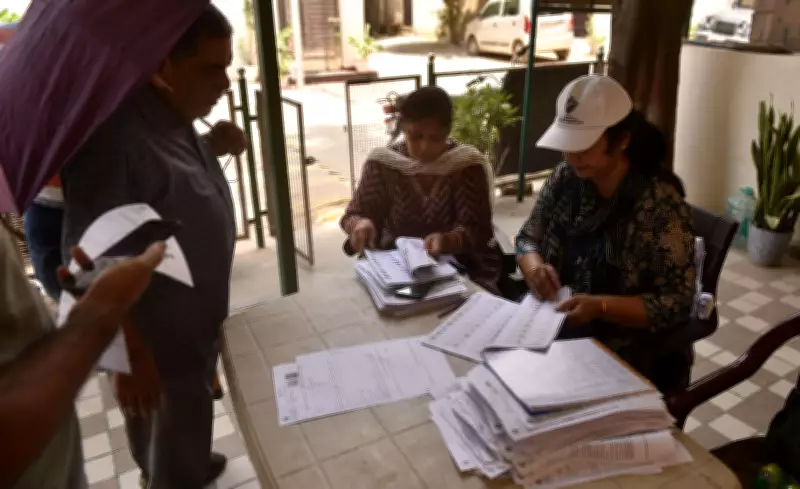
Voters in Telangana who changed their residence without updating their address in the electoral roll may not receive enumeration forms during the ongoing Special Intensive Revision (SIR) and could find their names missing from the draft roll if they are not traced during verification, according to Chief Electoral Officer (CEO) C Sudharshan Reddy.
Enumeration Forms Delivered to Old Addresses
Speaking at a press conference on Saturday, Reddy explained that enumeration forms are being delivered based on the address recorded in the electoral roll. If a voter has moved from one locality to another—for example, from Kukatpally to Gandhinagar—without updating the record, the form will be sent to the old address. “If the voter is not found there, the person may be marked as ‘shifted’ or ‘absent’ during the verification process,” he said.
Reddy clarified that such voters would not automatically lose their voting rights permanently, but they might not appear in the draft roll unless they complete the required process. Voters who have shifted residence must submit Form 6 for fresh registration at the new address or Form 8 for corrections and updating details.

First SIR in 24 Years Aims to Clean Rolls
The SIR, being undertaken in Telangana after nearly 24 years, aims to clean up the electoral rolls by identifying deceased, shifted, and otherwise ineligible entries while ensuring eligible voters are retained. Reddy said that electoral registration officers (EROs) will function as quasi-judicial authorities during the notice period.
Before any voter’s name is removed, the ERO must verify documents, examine the case, and issue a “speaking order” explaining the reasons for the decision. This process is intended to ensure no eligible voter is excluded and no ineligible voter remains on the rolls.
85 Lakh Anomalies Identified
The CEO revealed that around 85 lakh electors have been identified across 11 categories of anomalies. These cases will be examined during the revision process. He also clarified that failure to be mapped with older records does not automatically result in deletion from the electoral roll.
Door-to-Door Drive from June 25
The preparatory phase of the exercise runs from June 15 to June 24, including printing forms, deploying staff, and training booth-level officers (BLOs), EROs, and district collectors. The enumeration phase will take place from June 25 to July 24, during which BLOs will conduct door-to-door visits to distribute and collect forms.
According to Reddy, every BLO will be responsible for covering all households in a polling station area, comprising about 1,000 to 1,200 voters. In urban areas, where identifying residents may be more challenging, assistants familiar with local neighborhoods may be engaged to support the exercise.
Each enumeration form carries the voter’s name, photograph, and the name and phone number of the concerned BLO. Two forms will be filled for every voter: the BLO collects one copy, while the second, signed copy, is handed over to the voter as an acknowledgment.
Deadline and Documentation
Reddy reiterated that all completed forms must be submitted by July 25 and said there will be no extension beyond the deadline. While a list of 12 documents has been prescribed, the ERO may consider other government-issued documents in cases where specific documents are not available in the state. Voters whose details match records from 2002 may not need to furnish additional documents. Submission of a new color photograph is optional and intended for those wishing to update their image in the electoral roll.
Mapping Progress and Transparency
The CEO said statewide mapping has reached 70.5%, with rural constituencies recording higher progress—many crossing 80% and some nearing 99%. Urban districts continue to lag, with mapping at 45.5% in Hyderabad, 43.5% in Medchal, and 56.5% in Rangareddy.
To ensure transparency, BLOs have been directed to hold weekly meetings with booth-level agents (BLAs) of recognized political parties and submit photographs and minutes of those meetings to the EROs. Reddy said strict action would be taken against any staff member found intentionally committing mistakes or providing misleading guidance during the revision process.