

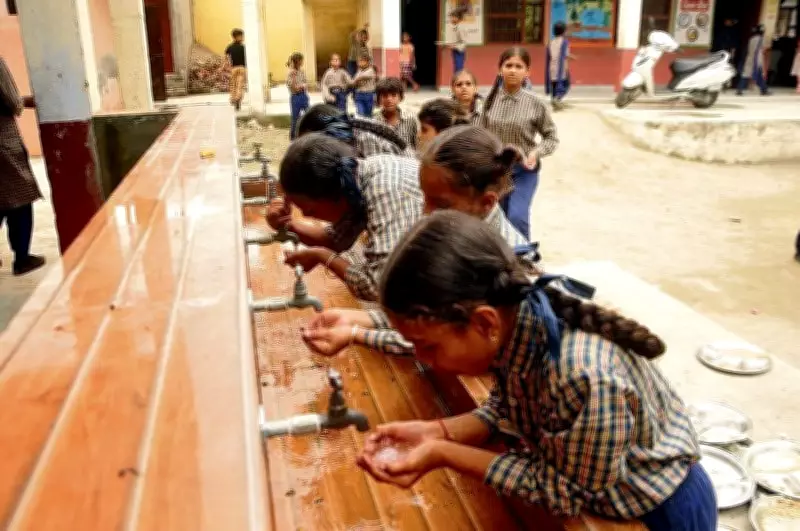
Water Audits Ordered for Amritsar Government Schools
The District Education Department in Amritsar has directed school management committees of several government schools to conduct water testing and audits, focusing on drinking water sources and groundwater levels on campus. This initiative aligns with Punjab's e-GREEN Sustainable Schools Initiative, which has been active since 2019.
Under the structured programme designed by the Punjab State Council for Science and Technology, Pushpa Gujral Science City, and the School Education Department, all government schools are required to perform water audits either during the summer break or before its commencement each year.
Scope of Water Testing and Audits
Rajesh Sharma, then District Education Officer of Amritsar (since transferred to Gurdaspur), explained that schools were instructed to test water quality and assess groundwater levels. Many rural government schools have installed borewells up to 350 feet deep. In schools dependent on municipal water supply, total dissolved solids (TDS) levels and overall water quality will be checked, and reverse osmosis (RO) systems installed where necessary.

Government schools are also collaborating with non-governmental organisations (NGOs) to support the audits, with funds from the Sikhiya Kranti initiative being utilised for this purpose.
Punjab's Green School Programme Recognition
In 2025, Punjab received recognition for its Green School Programme, a joint initiative of the Punjab State Council for Science and Technology and the School Education Department. Schools undergo rigorous environmental audits covering six key areas: water, energy, livelihood, food, land, and air. The programme aims to optimise resource management and has been conducted at the national level, highlighting Punjab's leadership in promoting environmental sustainability and awareness in schools.
Out of 11,917 schools registered from Punjab for the 2024-25 cycle, 7,406 completed environmental audits, accounting for 84 per cent of all audits conducted across the country. A total of 196 schools, including 171 government and 25 private institutions, were awarded Green School status. Hoshiarpur received the Best District Award after setting a national record by completing audits in 1,945 schools, the highest for any district in India.
Challenges and Ongoing Inspections
Currently, schools are lagging in completing audits as teachers and many officials remain engaged in election-related duties, the Census, and the Special Intensive Revision (SIR) exercise. Despite these challenges, efforts continue to ensure water quality monitoring.
Vijay Dutt, member of the Punjab Food Commission, has been conducting inspections of government schools, assessing water quality, reviewing water audit processes, and training teachers on monitoring drinking water quality.






