Bombay High Court Seeks Legal Guidance on ART Age Limit Challenge
The Bombay High Court has taken a significant step in a case concerning reproductive rights by appointing an amicus curiae, or friend of the court, to provide legal assistance. This decision came last week in response to a petition filed by two women, aged 53 and 55, who are challenging the age restrictions imposed by Maharashtra's Assisted Reproductive Technology (ART) Act, 2021.
Petitioners Challenge Constitutional Validity of Age Limit
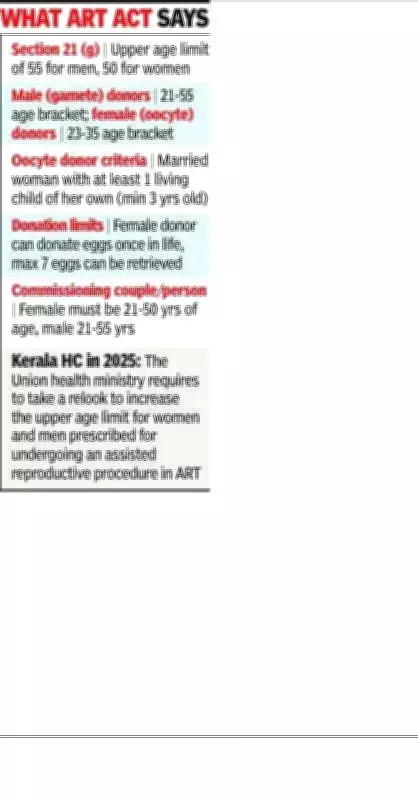
The women have specifically targeted Section 21(g) of the ART Act, 2021, which establishes boundaries for when ART clinics can legally offer services like in vitro fertilization (IVF) to commissioning couples or individuals. They argue that this section is unconstitutional and should be struck down. Their primary contention revolves around the disparity in age limits: while the law permits men up to age 55 to donate sperm, it sets a cutoff of 50 years for women to accept donor gametes.
In their petition, the women sought interim relief, requesting permission from the High Court to undergo assisted reproductive techniques, including sperm donation, to conceive a child. They both presented medical certificates from a gynecologist stating they are fit to deliver a child, aiming to support their case for medical fitness despite their ages.

Court Notes Lack of Research-Backed Data
However, a division bench comprising Justices R V Ghuge and Abhay Mantri observed that the petitions lacked analytical data based on medical science and research. The bench emphasized that there was no research-backed submission to demonstrate that the women could be medically fit to bear a pregnancy at their advanced ages. This gap in evidence prompted the court to seek expert legal guidance.
The court stated, "In such matters, where the claims are not supported by any analytical data based on medical science and research, we are of the view that an amicus curiae needs to be appointed to assist the court." To this end, the bench requested senior advocate Ashutosh Kumbhakoni, a former advocate general, to assist, and he has agreed to take on the role.
Background on Maharashtra's ART Act Provisions
The Maharashtra government introduced specific conditions in the ART Act, 2021, regulating reproductive technologies. According to the act, a male sperm donor is allowed to donate up to a maximum age of 55 years. Conversely, a woman who is to accept the donated sperm and nurture the fetus in her womb can be a recipient only up to 50 years of age. This legislative framework is now under scrutiny as the petitioners argue it unfairly discriminates based on gender and age.
The case highlights ongoing debates about reproductive rights, age discrimination, and the intersection of law with medical advancements in assisted reproduction. The appointment of an amicus curiae is seen as a move to ensure a thorough legal examination of these complex issues, balancing individual rights with regulatory concerns.
Next Steps and Urgent Hearing Scheduled
The Bombay High Court has posted the matter for an urgent hearing on April 22, indicating the significance and time-sensitive nature of the case. As the legal proceedings unfold, the outcome could have broader implications for reproductive laws and age-based restrictions in India, potentially influencing future amendments to the ART Act or similar legislation in other states.
This case underscores the evolving landscape of assisted reproductive technologies and the legal challenges that arise as societal norms and medical capabilities advance. The court's reliance on an amicus curiae reflects a cautious approach, aiming to base decisions on robust legal and medical insights rather than solely on petitioner claims.