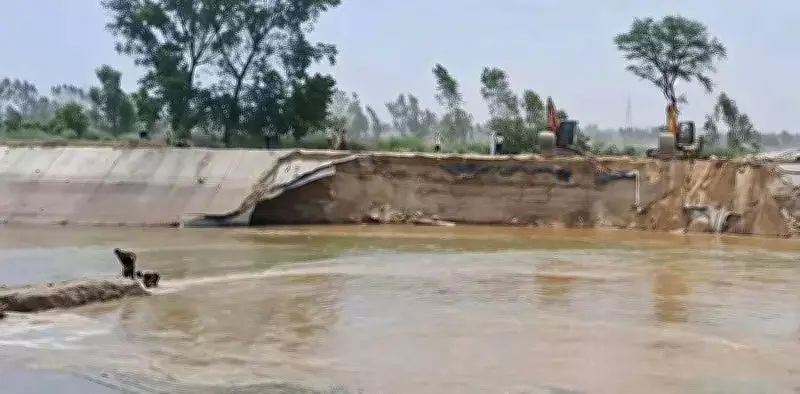
Bathinda: A wide portion of the newly relined Rajasthan Feeder Canal was washed away near Fidde village in Faridkot district on Friday, just days after water was released on the stretch. However, as the earthwork behind the concrete lining remained intact, water did not flow out of the canal. The concrete relining is suspected to have been washed away due to seepage between the slabs.
Relining Work Completed Recently
A source from the Punjab water resources department stated that a major portion of the canal was relined a long time ago, but the remaining nearly 12-kilometre area was completed only a few days ago. The department has deployed workforce to prevent any probable water loss, but farmers are raising questions over the quality of construction work.
Farmers Demand Investigation
Farmers Karnail Singh and Mohinder Singh expressed concerns, saying, "Over 100-feet portion was washed away after water was released. This points towards the quality of construction, which needs to be fairly investigated. If any breach had occurred, it could have inundated the fields."

Background of Rajasthan Feeder Canal
The Rajasthan Feeder, which runs parallel to the Sirhind Feeder Canal, originates from Harike headworks and has a total length of 204 kilometres, with 151 kilometres in Punjab territory. It was constructed with a capacity of 18,500 cusecs, but over the years, its carrying capacity had reduced to as low as little over 15,000 cusecs. The Union Government had approved the relining in September 2018. Major construction work was completed a long time back, and approximately 12 km of relining work, which was pending, was now completed.
Following demands from local farmers and residents to facilitate groundwater recharge, the stretch in Faridkot district was brick-lined at the bed.
Official Response
Punjab water resources department principal secretary Krishan Kumar did not respond to calls and text messages. An executive engineer-level officer, not wanting to be named, said, "It is expected that water seeped through the joint of old relining and new relining." He added, "The department immediately put workers and machinery in service, and water continued to flow as sandbags were placed at the spot where concrete lining washed away."