From Courtroom to Davos: The Unusual Journey of Financial Fraud Accused
While global business leaders typically embark on their journeys to the World Economic Forum in Davos from corporate boardrooms worldwide, for Farid Hamid Sama, an accused in the massive Rs 4,733 crore Dewan Housing Finance Corporation Ltd (DHFL) fraud case, his path to the Alpine conference began in a high-security Mumbai courtroom. On January 19, 2026, a special court granted Sama, currently out on bail, permission to temporarily exchange his "flight risk" status for a business suit in Switzerland, allowing him to attend the prestigious conference from January 20 to 27.
The Growing Trend of Travel Permissions in Financial Fraud Cases
In Mumbai's specialized courts handling financial crimes, such travel applications have become increasingly common. In one courtroom dealing exclusively with money laundering and related offenses, approximately 12 out of 46 orders passed since January 1 this year involved approving accused persons' travel itineraries. Similarly, in cases primarily investigated by the Central Bureau of Investigation (CBI), 17 out of 69 orders permitted international travel.
The Yes Bank case provides particularly striking statistics: out of 34 orders pronounced in 2025, around 30 dealt with accused individuals seeking permission to travel to destinations including New Zealand, Turkey, and Scotland, citing business obligations, leisure activities, or family commitments.
Legal Reasoning Behind Travel Approvals
In Sama's case—which forms part of a broader investigation into fraud estimated to exceed Rs 34,000 crore—the court emphasized constitutional protections. "The right to travel abroad is an aspect of fundamental right guaranteed under the Constitution of India... No prejudice will be caused, if the applicant is permitted to travel as prayed," the judge reasoned, despite strong opposition from the CBI.
The prosecution argued that frequent international travel by high-profile accused could prejudice justice administration, suggesting that defendants were beginning to treat court-granted leniency as routine rather than exceptional. However, the court maintained that the fundamental right to travel abroad, protected under Article 21 of the Constitution, cannot be restricted without compelling evidence of immediate risk.
Notable Cases and Travel Patterns
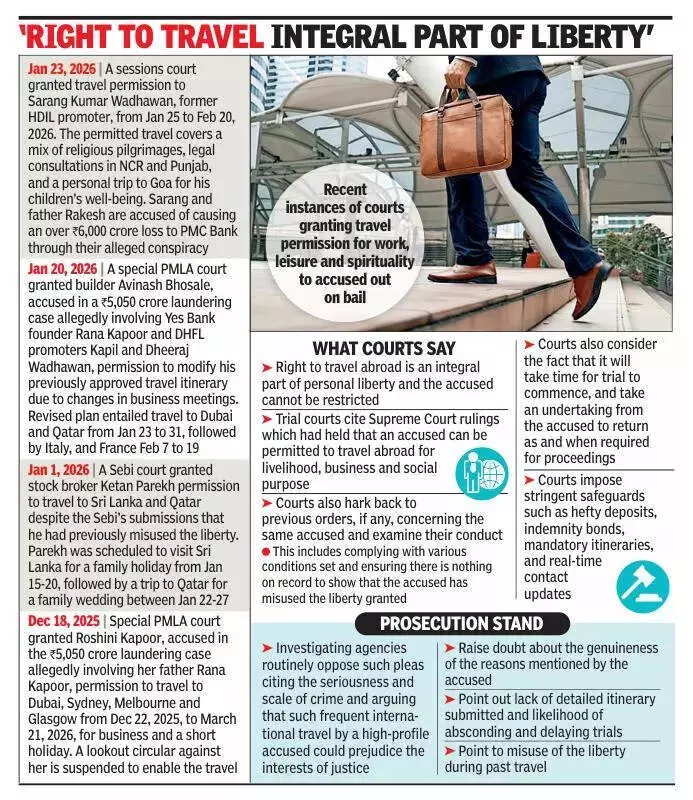
Several high-profile cases illustrate this trend. Builder Avinash Bhosale, an accused in a Yes Bank PMLA case involving Rana Kapoor, successfully modified his travel restrictions to include Dubai, Qatar, Italy, and France throughout early 2026. Similarly, Ashish Agrawal, another accused in the same case, secured permission for business trips to Dubai in February and April 2026.
Business obligations and tourism remain primary drivers for international travel requests. Accused individuals including Chandra Khandelwal, Sudarshan Roongta, and Harshvardhan Roongta sought extensive six-month tours covering global financial and leisure hubs like the United Kingdom, United States, Singapore, and Mexico. The prosecution opposed these pleas, highlighting the seriousness of offenses involving 13,000 investors and a Rs 5,600 crore fraud related to the National Spot Exchange Limited (NSEL).
Family, Religious, and Personal Reasons for Travel
Travel applications frequently escalate during the December-January vacation window for family bonding and milestone celebrations. Fraud accused Amit Mukherjee and his wife Bonhi requested a month-long visit to London to attend their daughter's graduation ceremony on January 20. In another case, 77-year-old Canadian citizen Arun Kashyap, accused of cheating Global Trust Bank, sought to return to his permanent residence in Dubai to be with his wife.
Religious obligations also serve as significant justifications. Former HDIL promoter Sarang Kumar Wadhawan, accused of causing over Rs 6,000 crore loss to PMC Bank, characterized his proposed domestic visits to Gujarat and Rajasthan as "sacred pilgrimages" of "profound religious significance." Similarly, businessman Aamir Gazdar, accused in a Rs 200 crore money laundering case allegedly involving controversial preacher Dr. Zakir Naik, sought nine-day leave to travel to Saudi Arabia for the Holy Pilgrimage of Umrah.
Prosecution Concerns and Judicial Safeguards
Investigating agencies consistently oppose international travel applications, citing perceived risks to judicial processes and the gravity of alleged crimes. They argue that the seriousness and scale of high-profile offenses make accused persons significant flight risks, suggesting frequent travel could prejudice justice or intentionally delay trials.
Despite these concerns, courts have established stringent safeguards. Security deposits typically range around Rs 1 lakh, though they can reach Rs 5 lakh in some instances. Courts also require detailed itineraries, indemnity bonds, and real-time contact updates. In the case of National Congress Party (NCP) leader Chhagan Bhujbal, then accused in a money laundering case, a special court permitted travel to the UAE, Morocco, Kenya, and Qatar for a family holiday in December 2024, noting his deep social and political roots made flight unlikely.
Legal Precedents and Constitutional Protections
The legal foundation for these permissions stems from the landmark 1978 Maneka Gandhi versus the Union of India case, which established that the right to travel abroad constitutes an integral aspect of "personal liberty." Recent judicial rulings have refined this principle, requiring the state to provide "cogent evidence" of potential misuse before restricting movement.
The Bombay High Court has emphasized that "the right to travel abroad has been considered to be a facet of the right to life and personal liberty and, thus, cannot be subjected to unreasonable and arbitrary restrictions, even when a person is facing prosecution." While trial courts can impose conditions for travel, they "ought not to be so onerous that the right to travel abroad itself is defeated."
Exceptions and Denials
Not all accused receive travel permissions as a matter of right. In February 2025, the Supreme Court rejected Indrani Mukerjea's plea to travel abroad during her daughter Sheena Bora's murder trial, observing "There is no guarantee that you will come back." Similarly, a special court for Securities and Exchange Board of India (SEBI) cases initially rejected stock broker Ketan Parekh's travel request due to concerns about potential securities law violations, though subsequent permission was granted with strict conditions.
As Mumbai's courts continue balancing constitutional rights with judicial security concerns, the trend of granting international travel permissions to financial fraud accused reveals the complex interplay between individual liberties and legal accountability in India's evolving financial crime landscape.