High Court Sets 7-Day Deadline for Punjab Government on Jailed MP's Parliament Attendance Request
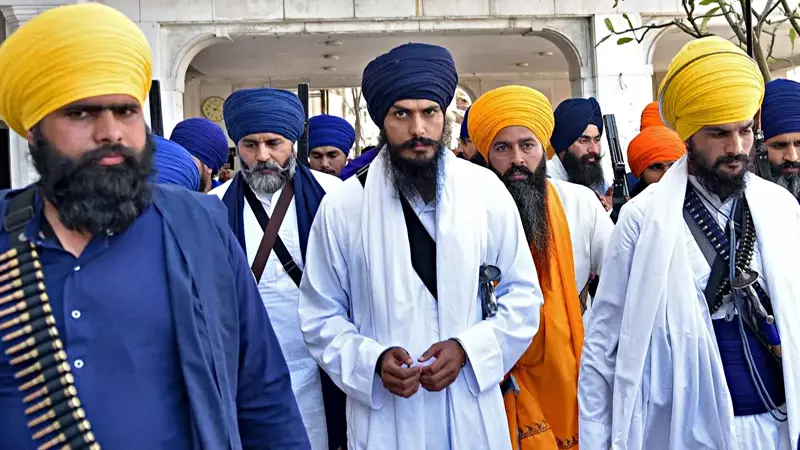
The Punjab and Haryana High Court has issued a significant directive to the Punjab government, granting it seven working days to decide on the representation of detained Khadoor Sahib MP Amritpal Singh. The MP, currently lodged in Assam's Dibrugarh jail under the National Security Act since 2023, seeks permission to attend the upcoming Budget Session of Parliament scheduled to commence on January 28.
Judicial Proceedings and Key Arguments
A division bench comprising Chief Justice Sheel Nagu and Justice Archana Puri delivered this order on Friday, following a hearing on Singh's petition. The petition specifically requests relief to enable his presence in the Lok Sabha during the crucial Budget Session. This development comes just a day after Justice Sanjiv Berry recused himself from the matter, adding a layer of judicial complexity to the case.
During the proceedings, Additional Solicitor General Satya Pal Jain presented a noteworthy argument. He pointed out that Singh's absence from parliamentary sittings due to his detention has already been condoned to a substantial extent. Jain elaborated that according to Lok Sabha rules, a member faces disqualification only after being absent for 60 sittings without permission. Singh has missed 32 sittings so far, all of which have received condonation.
The counsel further clarified that for any remaining absences, the Lok Sabha typically grants condonation when an MP is unable to attend due to detention, provided a formal application is submitted. This legal nuance underscores the procedural aspects governing parliamentary attendance and the protections available to detained members.
Court's Deliberations and Final Order
The petitioner's counsel, Imaan Singh Khara, urged the court to allow the state government just five days to decide on the MP's representation. However, Chief Justice Nagu highlighted that three holidays within that period would leave insufficient effective time for authorities to make a proper decision.
The bench carefully noted that the petitioner was only seeking a decision on his representation and not an automatic right to attend parliamentary sessions. Consequently, the court directed the competent authority—specifically the Home Secretary of Punjab—to decide on the representation within seven working days.
Emphasizing the importance of timely communication, the court ordered that the decision's outcome must be promptly communicated to the petitioner in jail and to his legal counsel. This ensures transparency and allows for potential further legal action if necessary.
Background and Previous Attempts
This is not the first time Amritpal Singh has sought permission to attend Parliament. The Waris Punjab De chief had previously requested similar permission for the Winter Session, but the state government declined his application. His subsequent legal challenge became infructuous as the Winter Session had already concluded by the time the matter reached the court.
Singh's current petition, filed on Wednesday, specifically seeks directions to state authorities to grant him parole for parliamentary attendance and make necessary arrangements for his participation. The case highlights the ongoing tension between parliamentary privileges, legal detention, and the rights of elected representatives.
The High Court's intervention comes at a critical juncture, with the Budget Session—where important financial legislation and policy discussions occur—just days away. The court's measured approach, balancing the need for a timely decision with sufficient deliberation time for authorities, reflects the complex interplay between judicial oversight and executive decision-making in matters of parliamentary privilege and national security.