

Misrod Emerges as Bhopal's Most Deadly Road Accident Zone in 2025
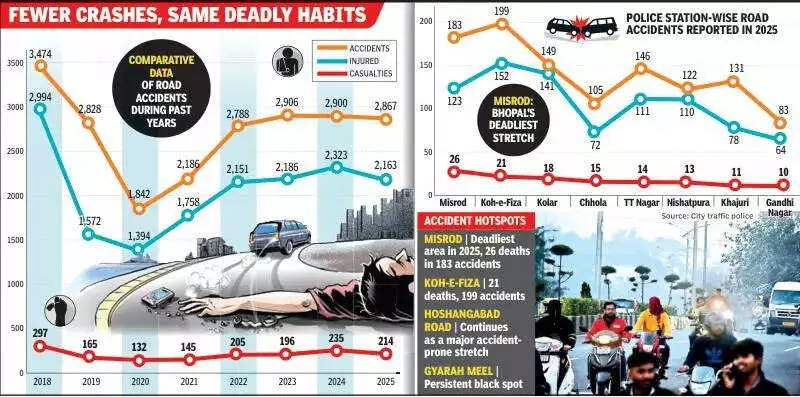
Bhopal witnessed alarming road safety issues in 2025, with Misrod area recording the highest fatalities according to city traffic police data. Twenty-six people lost their lives in 183 road accidents reported in Misrod during the year, while 123 others sustained injuries. This grim statistic places Misrod at the top of Bhopal's most dangerous accident-prone locations.
High-Fatality Zones Across the City
Following Misrod, Koh-e-Fiza ranked second with 21 fatalities in 199 road accidents and 152 injured persons. Kolar secured the third position with 18 deaths in 149 accidents and 141 injuries. Several other areas also featured prominently among high-fatality zones:
- Chhola recorded 15 deaths in 105 accidents with 72 injured
- TT Nagar reported 14 fatalities in 146 accidents with 111 injured
- Nishatpura saw 13 deaths in 122 accidents with 110 injured
- Khajuri and Gandhi Nagar also appeared with 11 and 10 deaths respectively
Overall Statistics Show Mixed Picture
Traffic police data reveals that 214 people died in 2,867 road accidents across Bhopal during 2025, while 2,163 individuals suffered injuries. Although overall casualties showed some decline compared to previous years, the risk remains critically high. Overspeeding emerged as the single biggest cause of accidents, with drunk driving identified as another significant contributing factor.

Night Driving and Celebrations Amplify Dangers
Senior traffic officials expressed particular concern about overspeeding on city outskirts during late night hours. Youngsters frequently travel to peripheral areas for birthday celebrations and parties during these times. Many violate multiple traffic norms simultaneously - overspeeding, riding without helmets, driving without seatbelts, and indulging in drunk driving. The dangerous combination of high speed and low traffic density at night frequently results in serious accidents.
Hoshangabad Road Remains Persistent Hotspot
Several accident-prone points were identified on the Hoshangabad Road stretch between ISBT and Samardha, falling under Govindpura, Bag Sewania, and Misrod police station limits. Assistant Commissioner of Police (Traffic) Milan Jain explained that better road conditions paradoxically contribute to more severe accidents. "When roads are congested, major accidents are rare. When roads are empty, people overspeed, lose control, and accidents happen. Most fatal accidents occurred at night due to overspeeding and drunk driving," she stated.
Jain added that after the removal of the BRTS corridor in Misrod, roads became wider and remained largely empty at night. Vehicles frequently enter the main carriageway from service lanes through unauthorized cut points without checking traffic, leading to dangerous crashes. Gyarah Meel continues to be a black spot, though negligence was identified as the primary cause in most road accident cases.
Infrastructure Issues Compound Problems
From Misrod to Samardha, railings were installed to separate service lanes from the Hoshangabad main road. However, shopkeepers and locals removed them in many places, allowing direct entry from service lanes to the main road. The traffic police wrote to concerned agencies to repair the railings and close unauthorized cut points.
Design flaws and poor lighting also contribute significantly to accidents in Koh-e-Fiza. ACP (Traffic) Vijay Dubey highlighted problems at Koh-e-Fiza Square on VIP Road. "At this junction, VIP Road turns left while vehicles heading towards Koh-e-Fiza take a right turn, creating confusion, especially at night. Accidents occur due to overspeeding and drunk driving," he explained. He noted that rising traffic volumes on VIP Road, Lalghati, and surrounding areas have increased congestion and safety risks.
Kolar Six-Lane Presents Speed Control Challenges
Officials from Kolar police and the traffic department acknowledged that overspeeding became rampant after the expansion of the Kolar Six-Lane due to the absence of effective speed control measures. A traffic officer observed that wide roads encourage drivers to speed even in commercial and high-traffic zones. He suggested installing speed breakers or rumble strips at major junctions and cut points.

Encroachment by hawkers and roadside parking on both sides of the road further aggravated the problem. A senior Kolar police officer pointed out that multiple cut points in the road divider pose serious risks. With commercial and residential complexes lining both sides of the road and heavy traffic during peak hours, uncontrolled crossings have turned this stretch into a potential accident trap.
The traffic police data paints a concerning picture of road safety in Bhopal, highlighting the urgent need for comprehensive measures addressing infrastructure, enforcement, and public awareness to reduce preventable deaths on city roads.





