

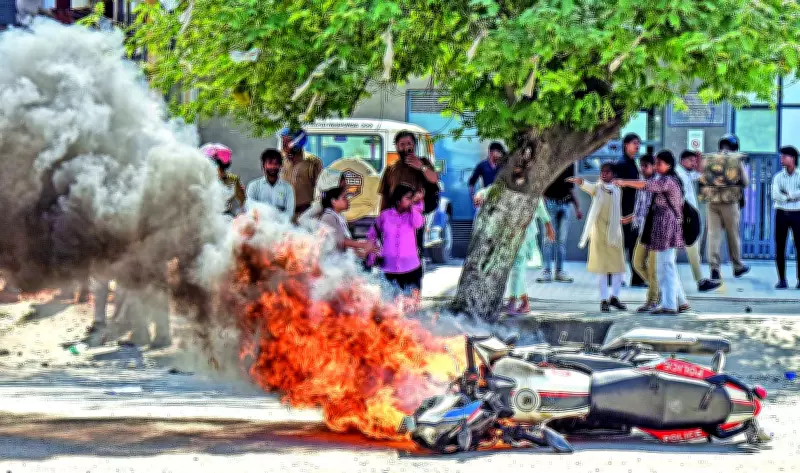
The National Human Rights Commission (NHRC) has taken suo motu cognisance of media reports detailing how a 16-year-old arrested during the April 13 industrial workers' agitation in Noida spent nearly two months in Kasna jail alongside adult prisoners. A court-ordered ossification test eventually confirmed his minority, but it took prison authorities six days after the test report was submitted on June 6 to transfer him to a juvenile home in Noida.
Details of the Incident
According to a Times of India report published on June 12, the teenager was arrested on April 14 from his residence by a Uttar Pradesh Police team and charged under multiple sections of the Bharatiya Nyaya Sanhita (BNS), including attempt to murder, unlawful assembly, rioting with deadly weapons, grievous hurt to a public servant, and criminal conspiracy, among others. He was also charged under the Prevention of Damage to Public Property Act and the Criminal Law Amendment Act. Despite securing bail on May 29, his family could not furnish the required bond of Rs 1.5 lakh, leading to his continued detention in Kasna prison with adults until June 18.
NHRC Action
The NHRC observed that the contents of the report, if true, raised a serious issue of human rights violation. It issued notices to the Uttar Pradesh Director General of Prisons (Administration and Reform Services) and the Director General of Police, seeking a detailed report within two weeks. The commission also directed its Director General (Investigation) to depute a team for a spot inquiry within a week.

Legal Process and Release
Advocate Manik Gupta, representing the minor, told TOI that the court initially set bail at a personal bond of Rs 50,000 with two sureties of the same amount while still treating the accused as an adult. An application under Section 12(1) of the Juvenile Justice (Care and Protection of Children) Act was filed seeking release on personal bond and reduction of surety. The sessions court reduced the surety to Rs 30,000 in the Phase II police FIR, with motorcycle papers furnished towards it. The court also ordered his release in the two remaining FIRs on personal bond, paving the way for his release on June 18.
Police Clarification and Controversy
The GB Nagar police commissionerate issued a clarification stating that the juvenile worked at Staunch Electronics India LLP, Sector 83, Phase II, and used an Aadhaar card issued in the name of Dinesh, son of Ramdeen, showing an age of 19 years. Police claimed that during his arrest on April 15, the juvenile identified himself as Dinesh. “During that time, even the medical report mentioned his age as 18 years, and a legal inquiry has been ordered into the entire episode,” the clarification stated.
However, Advocate Gupta contested this, alleging that police were attempting to cover up the matter after the NHRC issued a notice to the DGP. “The juvenile was never referred to by any alias in earlier cases. Now, suddenly, they have procured the Aadhaar card of his elder brother Dinesh and are cooking up a story,” he said. Gupta added that on Saturday, Dinesh was repeatedly contacted by police and pressured into recording a video stating that his younger brother took his Aadhaar card to enrol in a factory and was working there.
Impact and Concerns
The case highlights systemic failures in the juvenile justice system, where a minor was held with adult prisoners despite legal protections under the Juvenile Justice Act. The NHRC's intervention underscores the seriousness of the alleged human rights violations, and the commission has sought a detailed report within two weeks to determine accountability.






