Supreme Court Issues Stark Warning: Goa's Fragile Ecosystem Faces Destruction in Private Forest Case
The Supreme Court of India has delivered a powerful warning during a hearing concerning private forests in Goa, expressing grave concerns that the state's delicate ecosystem could be completely destroyed, transforming it into "another Mumbai." The observation came from a division bench comprising Justice B V Nagarathna and Justice Ujjal Bhuyan, who were hearing a case that has significant implications for Goa's environmental future.
Justice Nagarathna's Dire Prediction for Goa's Coastal Ecosystem
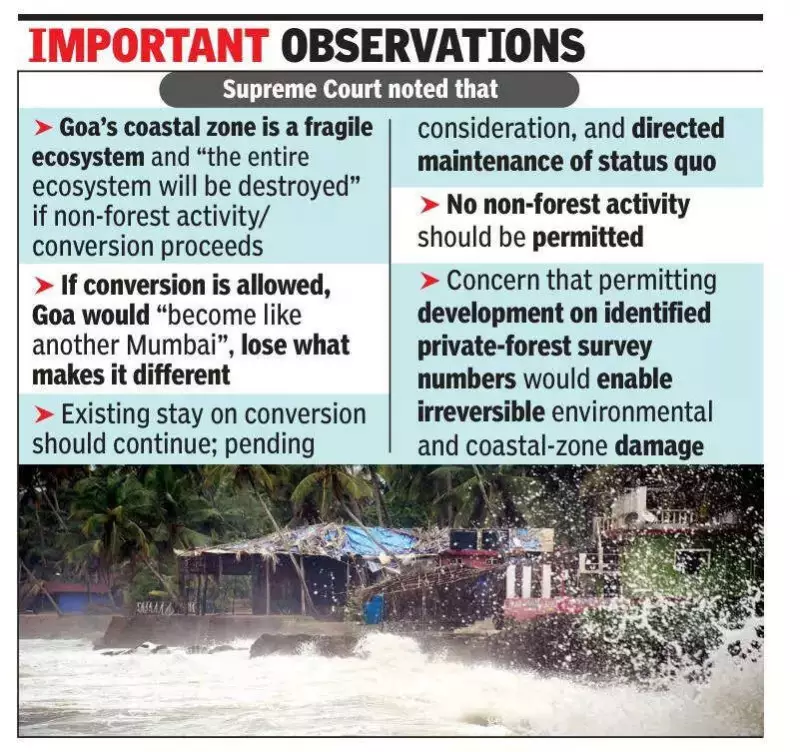
During the proceedings, Justice Nagarathna made a compelling statement that has resonated across environmental circles. "As of now there is a stay on conversion. Let that order continue. We'll say that now, pending consideration of this matter, let there be a status quo," she declared. The justice elaborated on the potential consequences, emphasizing the fragility of Goa's coastal zone.
"See, the entire coastal zone will be destroyed. It's a fragile area, ecosystem. The entire ecosystem will be destroyed. Goa will become like another Mumbai," Justice Nagarathna warned. She further questioned how Goa would maintain its distinctive character under such circumstances, noting that "Goans are fed up with these New Year programmes," hinting at the cultural and environmental shifts that could accompany unchecked development.

Alarming Details Emerge About Forest Area Deletions
Senior advocate Norma Alvares presented disturbing details to the court regarding the handling of private forest identification in Goa. She revealed that the private forest committee had initially demarcated 8.5 square kilometers as final forests, with an additional substantial area classified as provisional. However, a subsequent review committee decided to nullify this entire exercise and restart the process.
In what Alvares described as a concerning development, nearly 90% of the identified and finalized forest survey numbers were deleted during this review. She explained that the committee submitted comprehensive five-part final reports, but these faced significant challenges from the Goa Foundation, which contested the National Green Tribunal's judgment from September 23, 2023.
Methodological Concerns and Legal Challenges
Alvares raised serious questions about the methodology employed in reassessing forest areas. She described the approach as "very strange," explaining that authorities took digitized survey plans from the expert committee reports and superimposed them on Forest Survey of India's green cover maps, which are based on satellite imagery.
"Anything in the expert committee reports which did not align with the FSI maps, they deleted at the start without looking at it," Alvares informed the court. This process resulted in the deletion of a substantial number of finalized survey numbers, potentially opening these areas to development.
Supreme Court's Interim Protection and Ongoing Concerns
When these deletions were brought to the Supreme Court's attention, highlighting that development could proceed on these lands, the court responded with protective measures. On March 3 of last year, the Supreme Court issued an interim order stating that no conversion sanads would be issued for any of the final survey numbers, providing temporary protection for these areas.
Alvares clarified the legal implications: if survey numbers are identified as private forests, they can only be used for forest purposes. If they lose this designation, they become available for other uses. She noted that 18 parties had already received conversion sanads, with applications from 19 additional parties pending consideration.
The Broader Implications for Goa's Environmental Future
The Supreme Court's intervention and strong language reflect growing concerns about balancing development with environmental preservation in ecologically sensitive regions. The comparison to Mumbai serves as a powerful warning about the potential consequences of unchecked urbanization and development in Goa's fragile coastal ecosystem.

As the case continues, the Supreme Court has ordered that status quo be maintained, preventing any changes to the current situation while the matter receives thorough consideration. This decision provides crucial breathing space for environmental advocates and concerned citizens who fear irreversible damage to Goa's unique natural heritage.