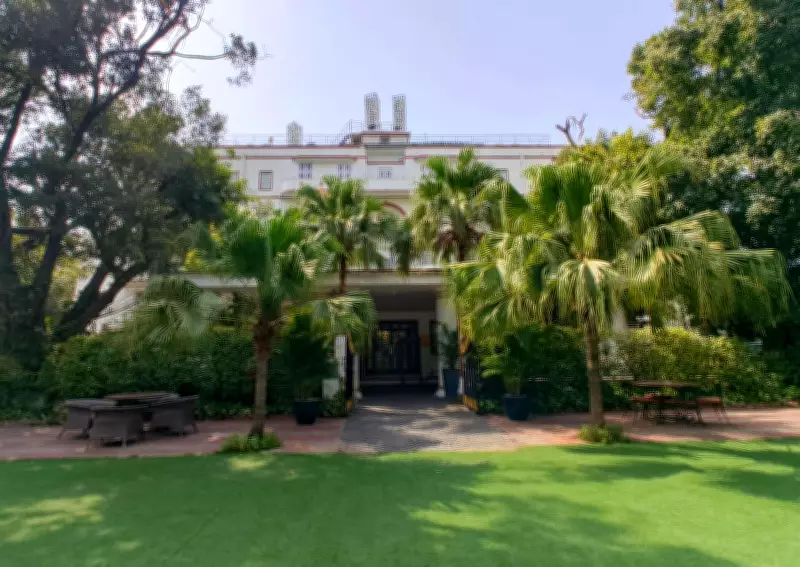
The Centre's move to reclaim the Ambassador Hotel in New Delhi has cast a shadow of uncertainty over the iconic property, even as daily operations continue. The Land and Development Office (L&DO) issued an eviction notice on June 11, days after a district court judgment strengthened the government's claim that the hotel was built on land originally designated for residential use.
Court ruling triggers dispute
In its June 9 order, District Judge Ajay Singh Shekhawat observed that the lease agreement “nowhere speaks of constructing a hotel block” and held that the developer, Sir Sobha Singh & Sons Pvt Ltd, had breached the terms by constructing a commercial hotel where residential units were to be built. The dispute over the 7.8-acre property dates back nearly 70 years, originating in the 1940s when the government allotted two plots near the junction of Cornwallis and Humayun Roads for residential flats. A lease agreement executed in 1945 required developer Sir Sobha Singh to build residential blocks according to approved plans, which later housed his son, Khushwant Singh.
Legal battle timeline
The dispute formally surfaced on January 3, 1956, when the government informed Sir Sobha Singh & Sons that structures on the northern plot violated the October 8, 1945 lease agreement. The government alleged that a public hotel had been constructed for commercial use and that garages and servants’ quarters were misused. While the government offered to condone the breaches subject to a revised agreement and additional charges, the company opposed the move, maintaining in February 1956 that all construction had official approval.

In 1960, the company approached a civil court and secured a status quo order, which remained in force until 2009 in favor of the hotel owners. The matter resurfaced this year after the Centre challenged the 2009 verdict. While the southern plot remains undisputed, the government contends that the hotel block and related structures on the northern plot violate the original allotment terms.
Impact on employees and businesses
For many associated with the landmark property, the legal battle has immediate personal consequences. Ratan Singh, manning the hotel’s front desk, said, “I don’t know about the legal intricacies regarding the establishment; like you, I will also get to know about our case status after July 23. Though yes, if it doesn’t get resolved, it might affect many jobs.”
Neighboring businesses also feel uneasy. Kishan Singh (name changed), who runs a café-cum-grocery store adjoining the hotel, said, “Even though the talk regarding eviction has mellowed after the high court’s order, we are hoping both parties arrive at a resolution. After all, this is one of the most sought-after establishments.”
Patrons recall cherished memories
For regular visitors, the Ambassador Hotel is tied to personal memories. A patron who has been visiting the Yellow Brick Road café for over two decades recalled, “Back then, when we had no Zomato or Swiggy, this was one of the few cafés that would run 24/7, and we would unwind after a long day at work.” Another patron added, “After a long day at office, when I would meet my friends there, we never felt rushed. Even at 1.30 am, they would let us sit and relax, and that meant a lot to us.”
Next steps in legal battle
Sir Sobha Singh & Sons Pvt Ltd has challenged the trial court’s order before the Delhi High Court, which has admitted the appeal and listed the matter for hearing on July 23. For now, life at the landmark property continues much as before, even as its future remains tied to the outcome of the long-running legal dispute.