

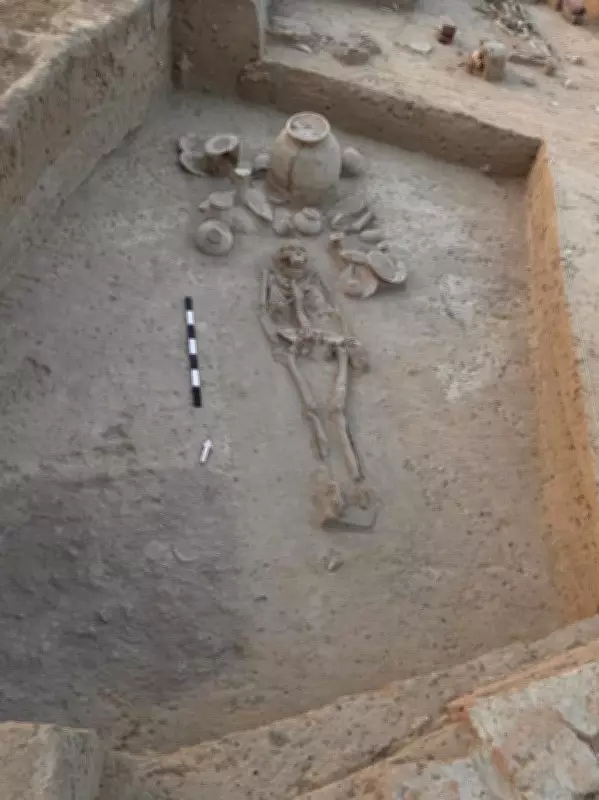
The Archaeological Survey of India (ASI) has uncovered eight skeletons from a mature Harappan burial site at Mound No. 7 in Rakhigarhi, the largest known site of the Indus Valley Civilisation (IVC). The discovery includes a record number of pottery offerings—nearly 40 per burial—along with shell bangles and gold beads, marking a significant find for understanding Harappan funerary practices.
Five Skeletons Retrieved, DNA Samples Sent for Analysis
Manoj Saxena, Superintending Archaeologist at ASI, confirmed that five skeletons have been retrieved so far from the burial site. Three of these were sent to the Anthropological Survey of India (AnSI) in Kolkata for examination, while samples from one skeleton were dispatched to the Birbal Sahni Institute of Palaeosciences (BSIP) in Lucknow for DNA extraction and analysis. The AnSI collected the skeletons on June 20 and is expected to deliver its analysis report within two to three months. Among the retrieved remains, two skeletons belong to women in their 40s, and one is of a male.
Record Pottery Offerings and Ornaments Found
For the first time at Rakhigarhi, excavators found nearly 40 pottery offerings accompanying each skeleton, surpassing the previous highest count of 27. Female skeletons were adorned with shell bangles on their hands and gold beads around them, providing insights into social status and cultural practices. Three skeletons were found damaged, likely due to decades of agricultural activity at the site.

Ongoing Excavations and Historical Context
The ASI, in collaboration with Deccan College, Pune, has recovered approximately 70 skeletons from Rakhigarhi over the past two decades. The latest excavation season began on February 22 and concluded in early June, with digging at Mound No. 7—the cemetery area—starting in May. The team also unearthed pottery, hearth remains, and domestic-use materials, offering a glimpse into daily life around 4,000 to 5,000 years ago.
New Discoveries at Mound No. 5
For the first time, ASI conducted excavations at Mound No. 5, revealing residential structures, beads, pottery, and objects of daily use. According to ASI officials, this area appears to have been an important social, economic, and cultural hub during the Harappan period. All skeletons and artefacts recovered will undergo scientific analysis, with officials noting that many more secrets remain buried beneath Rakhigarhi, promising to further enrich understanding of one of the world's earliest urban civilisations.






