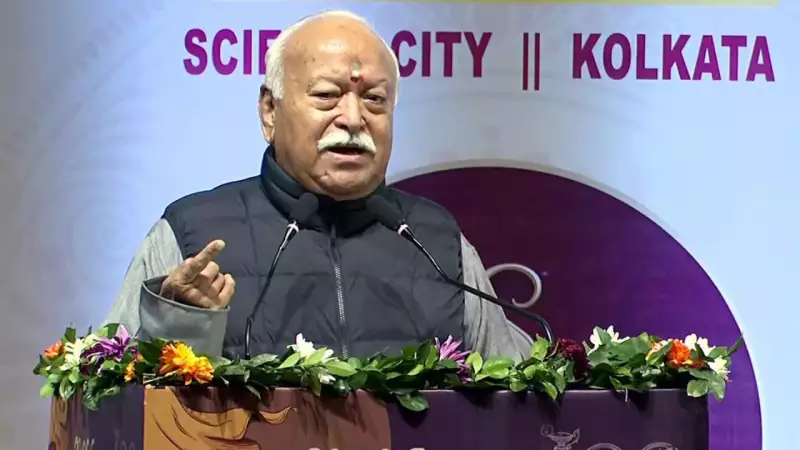
In a significant address aimed at clarifying the ideological stance of the Rashtriya Swayamsevak Sangh (RSS), its chief Mohan Bhagwat stated that viewing the organization through the political prism of the Bharatiya Janata Party (BJP) constitutes a "big mistake." Speaking at an event in Kolkata on Sunday, Bhagwat elaborated on the Sangh's core mission while attempting to draw a clear distinction between the cultural organization and its political affiliates.
Clarifying the Sangh's Identity and Purpose
During his speech at the Kolkata Vyakhyanmala, an interactive session held as part of the RSS centenary celebrations, Bhagwat spent over an hour explaining the genesis and growth of the Sangh. He directly addressed a common public perception, emphasizing that the RSS and the BJP are not one and the same. "Many have a tendency to understand Sangh through the lens of BJP. That is a big mistake," he asserted.
He explained the diverse roles of RSS volunteers, noting, "Swayamsevaks in Sangh work in varied fields. Some are in politics. Some are in the party in office (at the Centre)." This was a clear reference to the BJP, which leads the central government and has many members who are former RSS volunteers.

Defining 'Hindu' and the Goal of Social Organization
A central part of Bhagwat's lecture was dedicated to defining the terms "Hindus" and "Indian society." He argued that 'Hindu' is not merely a name but an attribute denoting a nature. "Those who respect their motherland are Hindus. They could have different languages, rituals, attire or eating habits," he stated, highlighting the diversity within the fold.
He outlined the Sangh's primary objective as the organization of the entire Hindu society, but was quick to add a crucial caveat. "The goal of the Sangh is organisation of the entire Hindu society, but it is not aimed at opposing others," Bhagwat clarified. He directly challenged narratives that paint the RSS as anti-minority, saying, "If you see that Sangh is anti-Muslim, you can make (that) your opinion. But change your opinion if you don't find that."
He urged the Muslim community to recognize shared ground, saying they might differ "in terms of worship" but are part of a unified entity in terms of "nation, culture and society."
On Politics, History, and Temple Construction
Bhagwat also touched upon political history and contemporary issues. He acknowledged the role of the Congress party in the freedom struggle, stating it was created as a means for political awakening. He also traced social reform movements back to figures like Raja Ram Mohan Roy.
On the contentious issue of religious structures, the RSS chief termed the proposed Babri Masjid a "political conspiracy" that serves neither community and is pursued "for the votes." He also criticized using public funds for building temples or mosques, citing the examples of Somnath and Ram temples. "The govt did not fund that (Somnath temple). Ram Mandir was not built by the govt. The govt should not get into the construction of temples," he emphasized, advocating for community-funded projects instead.
Throughout his address, Bhagwat stressed the need for an objective understanding of the RSS, warning against interpretations based on secondary sources and wrong narratives spread by its detractors.