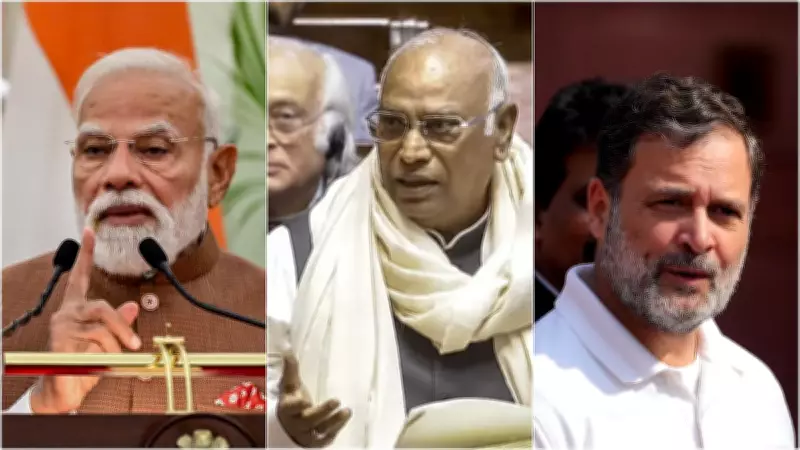
Congress Leaders Launch Scathing Attack on Modi Government Over Alleged Blackmail
Senior Congress leaders have launched a fierce political assault on the Narendra Modi-led government, accusing it of compromising India's strategic autonomy and national sovereignty. The controversy erupted following statements from Congress President Mallikarjun Kharge and General Secretary Jairam Ramesh, who took to social media platform X to voice their concerns.
Allegations of Blackmail and External Pressure
In a series of posts dated March 6, 2026, the Congress leaders made startling claims about the Prime Minister facing potential blackmail. Mallikarjun Kharge specifically referenced two high-profile cases: the Epstein Files and the Adani Case. According to Kharge, these matters are being used as leverage against the Indian government, putting the nation's independent decision-making capabilities at serious risk.
The core allegation suggests that external forces might be exploiting these sensitive issues to influence Indian policy. This development comes amid ongoing investigations and discussions surrounding both the Epstein scandal, which involves international figures, and the Adani Group controversy that has drawn significant political and financial scrutiny in India.

US Oil Waiver as Evidence of Compromise
Jairam Ramesh added another dimension to the criticism by referencing what he described as "Trump's new game." In his post, Ramesh questioned how long India would tolerate what he termed "American blackmail." The Congress leaders pointed to recent developments in India's energy policy as evidence of compromised sovereignty.
Kharge highlighted a specific instance involving the United States granting India a "30-day waiver" to purchase Russian oil. According to the Congress president, this arrangement where America "allows" and grants "permission" for such transactions demonstrates that the Modi government is operating under external constraints rather than making independent decisions in the national interest.
The implication is clear: India's energy security decisions are being influenced by foreign powers, with the US dictating terms rather than India exercising its sovereign right to secure energy resources from global markets.
Broader Implications for Indian Foreign Policy
The allegations raise serious questions about India's foreign policy independence at a time when global geopolitics is undergoing significant transformation. The Congress leaders suggest that:
- India's traditional policy of strategic autonomy is being undermined
- External pressures are influencing critical national decisions
- The government's ability to protect national interests is compromised
- India's position in global affairs may be weakening due to these alleged constraints
These accusations come at a sensitive juncture in India-US relations and amid ongoing global energy market disruptions. The reference to Russian oil purchases touches upon one of the most significant economic decisions facing India as it balances energy needs with international diplomatic considerations.
Political Fallout and National Debate
The Congress party's allegations have ignited a fresh political controversy that is likely to dominate parliamentary discussions and public debate. The serious nature of the claims—involving potential blackmail of the country's highest leadership—represents one of the most dramatic political accusations in recent memory.
As the opposition party raises these concerns, the government faces mounting pressure to address the allegations transparently. The coming days are expected to see intense political maneuvering as both sides present their arguments regarding India's sovereignty, foreign policy independence, and the integrity of its leadership in the face of international pressures.