The Indian Army's recently released Uniforms 2026 regulations have generated considerable discussion, largely because they are being viewed as another step in shedding the colonial inheritance that has accompanied the Army since Independence. That interpretation is not entirely misplaced. Yet it is also incomplete.
Uniforms as Repositories of Institutional Memory
Uniforms have never merely been about the cloth, badges, ceremonial distinctions or the arrangement of accoutrements. They are repositories of institutional memory, carrying within them the accumulated experiences of generations of soldiers, the victories and defeats of campaigns long forgotten by the public, and the values an army seeks to transmit from one generation to the next. Seen in that context, the new regulations deserve to be viewed not as an exercise in tailoring, but as part of a larger conversation about identity, history and the future direction of one of India's most respected institutions.
The temptation, of course, is to interpret every such change through the prism of decolonisation. There is a certain political attractiveness in doing so, for it allows complex historical processes to be reduced to a simple narrative of casting off the vestiges of foreign rule. The reality is considerably more nuanced.

Historical Evolution of Military Uniforms in India
By the time the British Indian Army emerged as one of the most effective military institutions in Asia, it had itself undergone a profound transformation at Indian hands. The Sikh Wars of the 1840s demonstrated to the British that military effectiveness in the subcontinent could not be achieved through rigid adherence to European practice alone. The armies of Maharaja Ranjit Singh represented a formidable fusion of indigenous martial traditions and modern military organisation. Many of the adaptations that followed in dress, fieldcraft and military culture owed as much to lessons learned in India as they did to ideas imported from Britain. Even khaki, now universally associated with soldiering, emerged from the dust and heat of the subcontinent rather than from the parade grounds of Europe.
The story of military uniforms in India has, therefore, never been one of simple inheritance. It has been a continuous process of adaptation, borrowing and evolution. Independent India inherited this complex legacy in 1947. At the time, the preservation of military cohesion mattered far more than symbolic change. The nation faced Partition, war in Jammu and Kashmir and enormous uncertainty. The Army retained its regimental system, traditions and much of its institutional structure because continuity was essential. It proved to be a wise decision. The institution that emerged from those turbulent years would go on to fight every major conflict in Independent India's history, earning new honours and creating traditions entirely its own.
Modern Context and the Need for Reform
Today, however, India is no longer a newly Independent nation searching for its footing. The defining battles of the modern Indian soldier were fought not under imperial colours, but under the Tricolour. From the mountains of Kashmir to the icy heights of Siachen, from the deserts of Rajasthan to the ridgelines of Kargil, successive generations have built a military legacy that belongs exclusively to Independent India. It is, therefore, natural that the Army should periodically reassess how it presents itself.
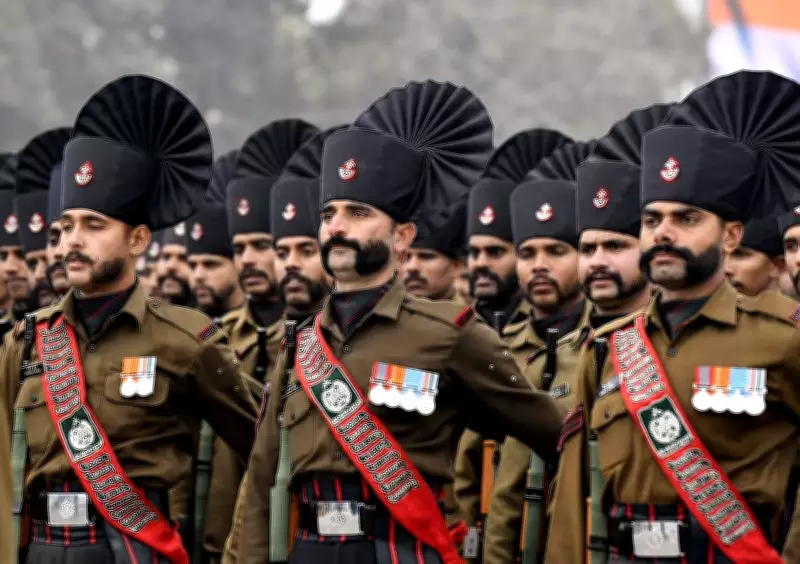
Yet there is another aspect of this discussion that deserves equal attention. Over the years, not only within the military but also across several paramilitary organisations, uniforms have gradually acquired a tendency towards excess. Decorative cords, flashes, badges, aiguillettes and assorted accoutrements have multiplied. The intention is invariably honourable. Every insignia tells a story. Every distinction seeks to recognise achievement, heritage or service. But there comes a point where ornamentation begins to distract from the very qualities it is intended to celebrate.

Elegance in Restraint and the Danger of Excess
The finest military uniforms possess an elegance rooted in restraint. Their purpose is not to draw attention to themselves but to the soldiers wearing them. When too many embellishments compete for attention, uniforms risk becoming caricatures rather than symbols of professional confidence. An army secure in its identity does not require excessive adornment to command respect. It earns that respect through discipline, competence and performance.
The same principle applies to military ceremony. A Passing Out Parade remains among the most moving occasions in a soldier's life. It marks the transition from cadet to commissioned officer and draws its power from solemnity rather than spectacle. The measured cadence of marching boots, the bark of commands, the anticipation visible on the faces of the cadets and the pride of their families require little embellishment.
Increasingly, however, one encounters attempts to make such ceremonies more theatrical, with elaborate running commentaries intended to explain every movement on the parade ground. The intention is undoubtedly to make proceedings more accessible to guests, but there is a danger that constant explanation diminishes rather than enhances the dignity of the occasion. Military ceremonies derive their authority from understatement.
Lessons from Field Marshal Sam Manekshaw
I was reminded of this while filming Field Marshal Sam Manekshaw as Reviewing Officer at the Indian Military Academy's Passing Out Parade in 2002. The ceremony itself possessed a solemnity that required no embellishment. When Manekshaw finally addressed the young officers, he did so with characteristic economy. “If you fail, don't come back. No one will look at you. Even your gharwali will not look at you.” Beneath the humour lay a timeless military truth. Soldiers are ultimately judged not by the complexity of their uniforms, the number of badges they wear or the splendour of ceremonial display, but by professional competence, leadership and performance in the field.
The Danger of Dismissing All Inherited Traditions
If there is one note of caution that should accompany the current enthusiasm for reform, it is the danger of assuming that everything inherited from the past is somehow tainted by its origins. Institutions such as the Indian Army endure not because they periodically reinvent themselves, but because they possess the wisdom to distinguish between traditions that merely reflect historical circumstance and those that continue to serve an enduring purpose.
The architects of the old British Indian Army, whatever their political motivations, possessed a deep understanding of Indian society and of what motivates men in combat. Military theorists may speak of national objectives, strategic interests and political aims, but soldiers rarely fight for abstractions. They fight for the men beside them. They fight because loyalty to comrades, platoons, companies and regiments creates bonds stronger than fear itself. The regimental system evolved because generations of military leaders understood this simple truth.
The Stories Behind Symbols
Perhaps this is where discussions of military reform occasionally lose sight of what gives military institutions their strength. Uniforms, badges and distinctions matter not because of their appearance but because of the stories attached to them. Every regiment possesses its own folklore, battle cries, customs and symbols. These are the threads that bind generations together. An officer commissioned today inherits not merely a uniform but a narrative stretching back through decades, and sometimes centuries, of service.
The Rajput Regiment's red and blue hackle provides a good example. To generations of Rajputs, the sight of that distinctive plume evokes an immediate emotional response. Its origins, however, lie not in some committee room but in the field. Battalions of the old 7 Rajput Group operating through the rhododendron forests of the Naga Patkai are said to have plucked the bright flowers and placed them in their blue pagris. Over time, a battlefield habit evolved into a regimental distinction.
Similar stories accompany the hackles of the Grenadiers, the Kumaon Regiment, the Brigade of the Guards and the Naga Regiment, to name just a few. To the uninitiated, they are merely adornments. To those who wear them, they are repositories of memory.
Symbols and Sacrifice: The Role of Battle Honours
This is why the debate over military symbols is rarely as straightforward as it appears. Soldiers do not become attached to traditions because of who first designed them. They become attached because those traditions become intertwined with regimental memory. Generations of officers and soldiers have lived and died beneath these symbols. Many who first wore them have long since passed away. Others remain, carrying memories of campaigns fought under circumstances very different from those faced by the Army today. Their emotional response to change deserves neither dismissal nor ridicule. Institutions that endure understand that symbols are powerful precisely because they connect the living with those who came before.
The same applies to Battle Honours. Every regiment carries its history upon its Colours and insignia. Behind every honour lies sacrifice. Real blood was shed to earn those distinctions. Some were won under the Union Jack, many under the Tricolour, but all were purchased at a cost measured in human lives. The young soldier who fell at Flanders, Gallipoli or El Alamein had no more control over the politics of his age than the soldier who fell in Kashmir, 1965, 1971 or Kargil. To erase one from institutional memory while celebrating the other would be to misunderstand the very nature of military history. Regiments do not remember governments. They remember sacrifice.
Balancing Evolution and Continuity
The Army Uniforms 2026 regulations therefore raise questions that go well beyond tailoring. The issue is not whether a badge, a lanyard or a ceremonial distinction originated during the colonial era. The more important question is whether it continues to contribute to the identity, cohesion and effectiveness of the institution that inherited it. Where the answer is no, change becomes both necessary and desirable. Where the answer is yes, caution is warranted, for traditions once discarded are seldom recovered.
The Indian Army's greatest strength has always been its ability to evolve without severing its connection to the past. That balance remains as important today as it was in 1947. For, an army is not defined by the cloth it wears, but by the stories, sacrifices and memories that the cloth represents. An army that forgets its history risks losing its soul. An army that refuses to evolve risks becoming a museum. The art lies in avoiding both extremes, preserving what gives meaning while discarding what no longer serves a purpose.
One hopes the latest changes continue that tradition, for it is that delicate balance, rather than any particular uniform, that has sustained the Indian Army through generations of war and peace.