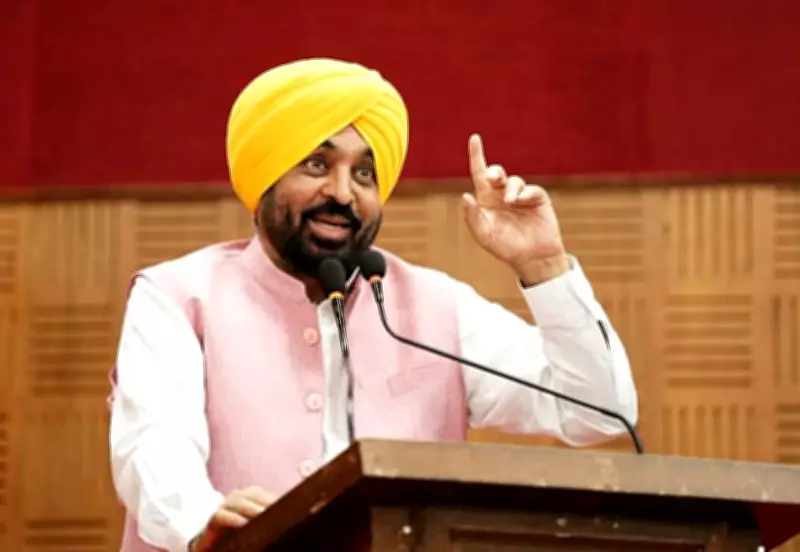
Punjab Chief Minister Bhagwant Mann has strongly opposed the Viksit Bharat Shiksha Adhiniyam Bill-2025, warning that the legislation could make higher education more expensive, weaken opportunities for students from ordinary families, and diminish the ability of states to address local educational needs.
Mann's Letter to Union Education Minister
In a letter to Union Education Minister Dharmendra Pradhan, Mann urged the Centre to reconsider the Bill and hold wider consultations before implementing reforms that could "significantly alter the higher education landscape." The CM said higher education must remain a pathway of opportunity for the child of a farmer, labourer or shopkeeper, not become a burden on families.
Mann asserted that India's progress depended on making higher education more accessible, affordable and inclusive through greater investment in universities, infrastructure, faculty and research, rather than measures that could increase costs and centralise decision-making.

Concerns Over Centralisation of Power
The CM said, "I initially hoped the proposed legislation will strengthen the quality, accountability and global competitiveness of higher educational institutions. However, after carefully studying the Bill, I have serious concerns that it seeks to centralise most important decisions relating to higher education, with far-reaching consequences for students, teachers, universities and state governments."
Raising his first major concern, Mann said the Bill appeared to focus more on centralisation of power than on improving educational quality. He observed that it was natural to expect a legislation on higher education to focus on quality, research, innovation, employability and global competitiveness.
Constitutional Balance at Stake
However, after studying the Bill, it appeared that its primary objective was to concentrate policy-making powers, standards, regulations, recognition mechanisms and appellate powers in the hands of the Union Government. "Education is a subject in the Concurrent List of the Constitution. Therefore, while minimum national standards may be desirable, states must retain the freedom to develop systems according to their own circumstances and needs. Unfortunately, this Bill appears to disturb that constitutional balance," he said.
The CM noted that state governments develop courses, skill programmes, industry collaborations and employment-oriented initiatives according to local requirements through universities and colleges. "If most educational decisions are taken by institutions sitting in Delhi, states will gradually lose their ability to understand local realities and design solutions accordingly. As a result, higher education risks becoming centralised and losing its practical relevance," he said.
Questioning Central Institutions' Credibility
Mann referred to the functioning of central institutions such as the National Testing Agency (NTA). "Recent years have raised serious questions regarding examination management, transparency and credibility. When central institutions themselves are struggling with such challenges, it is legitimate to ask whether further centralisation of higher education is really the right direction," he said.
"Centralisation of education could lead to higher fee, greater dependence on self-financed courses and increased reliance on private investment," he warned. Mann warned that the burden of such a model would fall most heavily on the middle class, lower-middle-class and poor families. "Higher education should be a pathway of opportunity. It should not become a privilege available only to those who can afford it," he said.
Call for Withdrawal and Comprehensive Review
The Chief Minister urged the Centre to withdraw the Bill in its current form and undertake a comprehensive review. "India does not need a legislation that further centralises higher education. What we need is a framework that allows universities and colleges to connect more effectively with the needs of their regions, industries, societies and youth," he said.

Mann referred to the objectives of the National Education Policy, 2020, which sought to raise the gross enrolment ratio in higher education to 50 per cent by 2035. "To achieve that goal, universities, colleges, research institutions and technical institutes need more resources, stronger infrastructure, modern laboratories, quality faculty and adequate research funding. They do not need additional layers of control," he said.