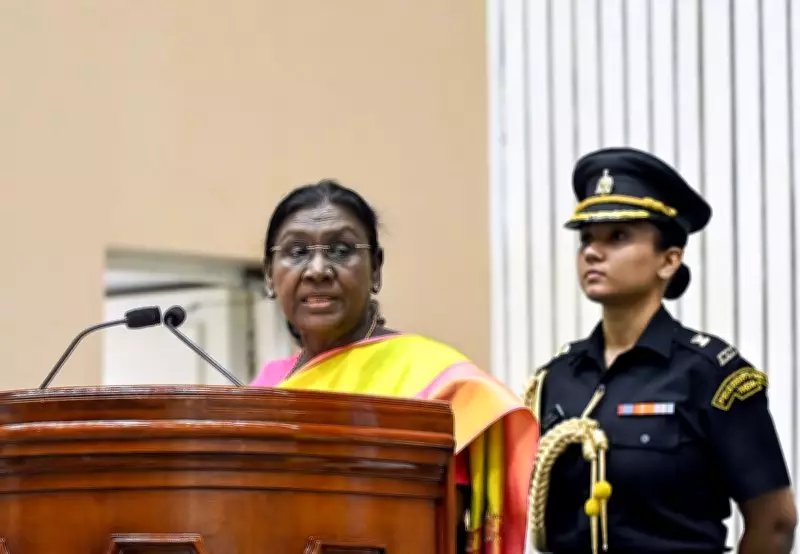
President Droupadi Murmu on Wednesday stated that tribal development is at the core of the vision of Viksit Bharat 2047, and urged the government to ensure that welfare schemes for the community reach their doorsteps.
Address at National Conclave
Speaking at the National Conclave on Strengthening of Integrated Tribal Development Agencies (ITDAs) and Integrated Tribal Development Projects (ITDPs) at Vigyan Bhawan in New Delhi, the President highlighted the importance of collective deliberation among state and project-level officials to generate constructive solutions. She described the conclave as a gathering of tribal change agents.
Tribal Talents and Challenges
Murmu noted that tribal communities are culturally rich and talented but often lack opportunities and confidence to enter the mainstream. She pointed out that many educated tribals face circumstances that hinder their progress and called on authorities to provide platforms for them to flourish.

Land Rights and Legal Records
The President raised the issue of landless tribals, stating that many community members believe the land they live on belongs to the Almighty and do not pursue registration. While many own land, they lack legal records, and often tribal land is taken away by state-owned agencies. She expressed hope that the conclave would produce a national roadmap to strengthen development agendas for tribal communities.
Financial Empowerment and Sports
Murmu advocated for financial empowerment of the community as a stepping stone toward development. She also called for major sports programs for tribal youth, citing the Kalinga Institute of Social Sciences (KISS) in Bhubaneswar as a model. KISS is a fully residential tribal institute that provides free education, world-class sports facilities, coaching, and nutrition to tens of thousands of tribal students, nurturing grassroots talent.
Healthcare: Sickle Cell Anaemia
The President urged greater awareness and screening for sickle cell anaemia among the tribal population. The disease disproportionately affects indigenous tribal populations globally, particularly in India, where about one in 86 Scheduled Tribe (ST) births is affected. The sickle cell trait evolved as a protective mechanism against malaria but is now passed down as a hereditary disease.
Preserving Culture and Education
Murmu expressed satisfaction that modern development efforts are accompanied by attention to the culture and knowledge traditions of tribal communities. She urged all stakeholders to contribute wholeheartedly to the education and skill development of tribal children and youth.