

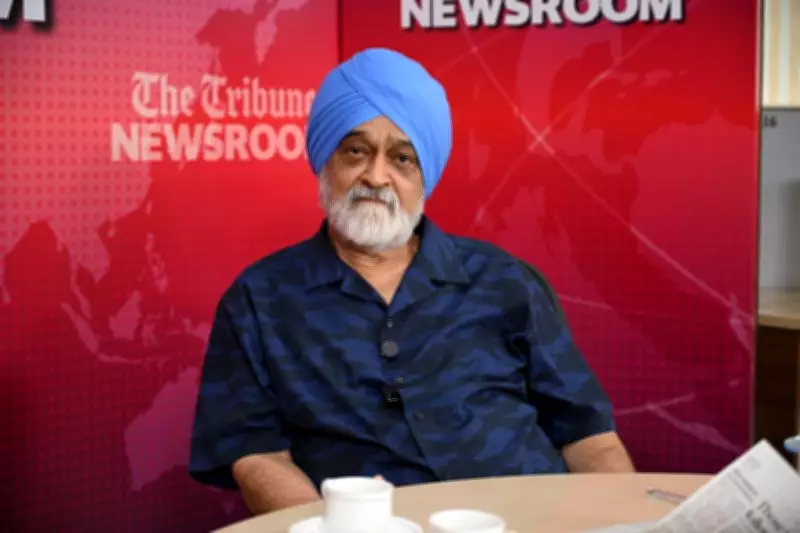
Former Planning Commission Deputy Chairman Montek Singh Ahluwalia stated that the now-repealed farm laws were fundamentally sound but were implemented too hastily. Speaking in The Tribune Newsroom, Ahluwalia emphasized the need for sustained economic reforms to achieve the Viksit Bharat 2047 target, which requires real growth exceeding 8 percent annually.
State of the Indian Economy
Ahluwalia identified the West Asia crisis as a short-term concern, noting that fuel prices could have reached Rs 120-130 per liter. He explained that oil prices may not decline soon due to damaged supply possibilities and drawdowns from strategic reserves. The capital account surplus has largely depleted over the past two years, attributed in part to investors exiting after making profits.
On the rupee crossing 100 to the dollar, Ahluwalia advised against excessive worry, stating that allowing depreciation is a legitimate strategy to manage balance of payments issues. He noted that India's export performance has been poor over the past five years, and a weaker rupee, while hurting importers, can help correct external imbalances.

Growth Targets and Reforms
Ahluwalia stressed that to achieve Viksit Bharat status by 2047, India needs real growth of over 8 percent. With current growth around 6 percent, he argued for targeting 9 percent to average 8 percent over the next 20 years, accounting for inevitable slowdowns. He criticized bureaucratic inertia, citing the reversal of a proposed ban on laptop imports as an example of ill-conceived decisions.
Addressing the ease of doing business, Ahluwalia highlighted the burden on small businessmen who must deal with multiple government offices. He called for genuine single-window systems and removal of unnecessary quality control orders, noting that only about 100 of 700 such orders were scrapped despite a high-level committee's recommendations.
Farm Laws and Subsidies
On agriculture, Ahluwalia defended the repealed farm laws but conceded they were rushed. He argued that keeping private marketing out of agriculture is wrong, as Punjab's agricultural sector has slipped in rankings. He advocated for targeting subsidies, pointing out that fertilizers are effectively given away at 8 percent of cost.
Ahluwalia also criticized free power to farmers, calling it a drain on Punjab's economy that has been replicated by other states. He warned that freebies, such as free bus rides for women, can deteriorate public services unless accompanied by adequate funding.
Inequality and Crony Capitalism
Responding to the World Inequality Report showing the top 1 percent hold 40 percent of wealth, Ahluwalia defended capitalism with guardrails. He argued that crony capitalism arises when political power is misused, not from capitalism itself. He noted that high duties on steel, aluminum, and plastics hurt small-scale sectors and foster cronyism.
On inequality, Ahluwalia suggested that faster growth benefits the poor absolutely, even if the rich gain more. He cautioned against low-level equilibrium where growth stagnates at 4 percent.
Fiscal Challenges and Freebies
Ahluwalia dismissed the idea of a 'deep state' preventing reforms, but acknowledged bureaucratic resistance. He praised the PM's 'reform, perform, transform' mantra but urged concrete actions in critical areas. On state debt, he noted Punjab is second last in debt-to-GSDP ratio and warned that the Centre cannot bail out every state.
He identified three biggest challenges to a Rs 5-trillion economy: improving ease of doing business, avoiding election-winning freebies, and pursuing open trade with trusted partners. He advocated joining the CPTPP, which excludes China.






