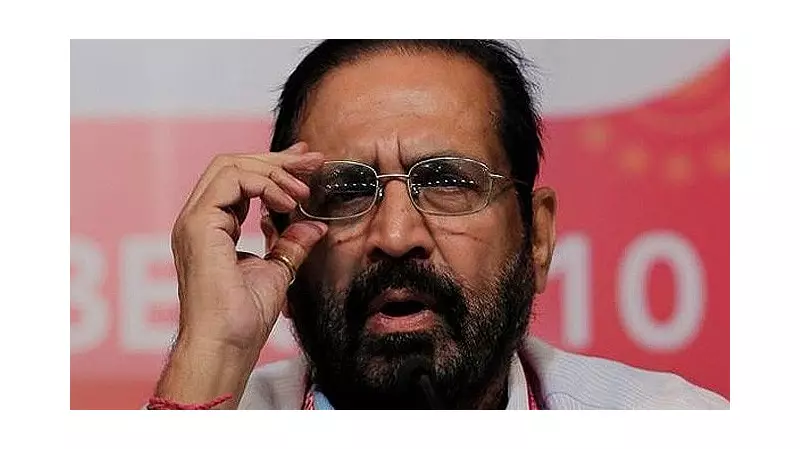
The passing of Suresh Kalmadi on September 23, 2024, at the age of 79, marked the end of a complex and highly eventful chapter in Indian public life. A figure of immense influence, Kalmadi's journey was a unique tapestry woven with threads from the skies, the corporate boardroom, the political arena, and the world of international sports.
From Cockpit to Corporate and Political Heights
Suresh Kalmadi's early career was defined by discipline and service. He joined the Indian Air Force as a pilot, a role that instilled in him a sense of structure and command. After leaving the IAF, he successfully transitioned to the business world, establishing himself as a prominent industrialist. This business acumen later became a significant asset in his political career.
His political journey was deeply rooted in Pune. He entered the Lok Sabha for the first time in 1982, winning a by-election from the Pune constituency as a candidate of the Indian National Congress. He would go on to represent Pune in Parliament for five consecutive terms, from 1984 to 2009, a testament to his strong local connect and political machinery. His influence within the Congress party grew steadily, and he held several key positions, including Minister of State for Railways during the tenure of Prime Minister P.V. Narasimha Rao.

The Sports Administrator and the Commonwealth Games Legacy
Parallel to his political career, Suresh Kalmadi built a formidable reputation in sports administration. His most prominent role was as the President of the Indian Olympic Association (IOA). However, it was his chairmanship of the organizing committee for the 2010 Commonwealth Games in Delhi that became the defining, and ultimately most controversial, part of his legacy.
Under his leadership, India hosted the Games, a massive sporting event that brought global attention to the country. The event was seen as a moment of national pride, showcasing India's organizational capabilities on a world stage. However, the aftermath was marred by serious allegations of financial irregularities, corruption, and mismanagement in the preparations for the Games.
These allegations led to a dramatic fall from grace. Kalmadi faced intense scrutiny, was removed from his posts, and faced legal proceedings. In 2014, he was arrested by the Central Bureau of Investigation (CBI) and spent several months in jail before being released on bail. The legal battles surrounding the Commonwealth Games case cast a long shadow over his earlier achievements.
A Life of Contrasts and Enduring Influence
Suresh Kalmadi's life was a study in contrasts. He was celebrated as a visionary who helped put Indian sports on the global map, yet was also vilified in connection with one of the nation's biggest corruption scandals. He was a powerful political satrap in Pune for decades, but his later years were spent away from the political limelight, battling health issues and legal challenges.
Despite the controversies, his impact on Pune's infrastructure and development during his long tenure as its MP is widely acknowledged. His role in elevating the profile of athletics and Olympic sports in India during his time at the IOA also remains a part of his story. His passing closes a tumultuous period, inviting reflection on a career that soared to remarkable heights before encountering severe turbulence.
The legacy of Suresh Kalmadi is thus multifaceted. It encompasses the decorated pilot, the savvy businessman, the influential politician, the ambitious sports administrator, and the accused figure in a major scandal. His story is inextricably linked to the narratives of modern Indian politics, sports management, and the complex interplay of power and accountability.