Shashi Tharoor Affirms PM Modi's Respect for Constitution Amid Internal Party Tensions
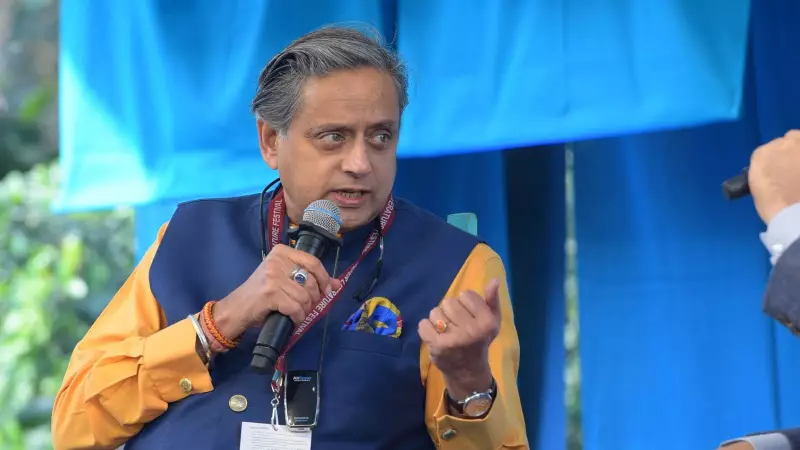
Congress Member of Parliament Shashi Tharoor made a significant statement on Saturday, declaring that Prime Minister Narendra Modi views the Indian Constitution as "sacrosanct." Tharoor referenced Prime Minister Modi's address to the United States Congress in 2016, where the Prime Minister famously referred to the Constitution as "his Holy Book." This observation was shared by Tharoor during his participation at the Kerala Literature Festival held in Kozhikode.
Constitution's Resilience Highlighted Amid Historical Context
In his address, Tharoor emphasized that the Indian Constitution has "stood the test of time," successfully navigating the political ascent of the Bharatiya Janata Party (BJP). He noted the historical irony, pointing out that the BJP's philosophical predecessors in the Rashtriya Swayamsevak Sangh (RSS) had once explicitly rejected the Constitution. Despite this, Tharoor asserted that the constitutional framework has endured and remained robust.
Tharoor further recalled the period following the BJP's rise to power, when there was widespread speculation and concern about the party's alleged intentions to discard the existing Constitution. He specifically mentioned reports involving RSS ideologue KN Govindacharya, who was said to be drafting a new constitution. Tharoor's comments serve to highlight the continuity and stability of India's constitutional democracy under the current administration.

Tharoor's Stance on Security and Governance Matters
The Thiruvananthapuram MP also reflected on his own political positions, particularly regarding national security. He stated that he had taken a strong and unapologetic stand on Operation Sindoor. Following the Pahalgam terror attack, Tharoor wrote a column for The Indian Express arguing that such acts must not go unpunished. He expressed surprise when the Modi-led government implemented measures aligning with his recommendations, showcasing a convergence of views on critical security issues.
Addressing Internal Party Differences and Leadership Dynamics
Tharoor's remarks arrive amidst growing speculation about his differences with the Congress party leadership and alleged attempts by state-level party leaders to marginalize him. In an interview with the Press Trust of India on the same day, Tharoor acknowledged having some "issues" with the party that he intends to discuss directly with the leadership. He stressed that internal disagreements should be resolved within the organization rather than through media channels.
"All I can say is that there are issues which I need to take up with my own party leadership and not in a public forum," Tharoor explained. "I will be going to Delhi for Parliament, and I will get an opportunity, I believe, to make my concerns very clear to the party leadership and get their viewpoint… have a proper conversation."
Asserting his long-standing commitment to the party, Tharoor added, "I have been in Congress for the past 17 years. Let’s not go too far… as far as I am concerned, whatever has gone wrong needs to be addressed, and it will be addressed in an appropriate forum." He also clarified that he has never deviated from the party's official positions in parliamentary proceedings.
Broader Political Commentary and Historical Reflections
Tharoor's comments are part of a broader discourse on political dynamics within India. In November 2024, he authored an article critiquing dynasty politics, wherein he observed that the Nehru-Gandhi family had "cemented the idea that political leadership can be a birthright." This perspective adds depth to his current reflections on party internal matters and constitutional governance.
The ongoing dialogue underscores the complex interplay between individual political stances, party discipline, and the overarching principles of democratic governance in India.