

West Bengal's 2026 Assembly Elections: Familiar Battle With New Strategic Dynamics
On the surface, West Bengal's 2026 assembly election appears to follow a well-established pattern. Chief Minister Mamata Banerjee finds herself once again at the heart of a deeply polarized political contest, confronting the Bharatiya Janata Party (BJP) as it strives to transform its 2021 electoral surge into actual governance power. The recurring themes remain unchanged: welfare programs versus administrative governance, regional identity versus national leadership, and the personal rivalry between Banerjee and Prime Minister Narendra Modi. However, beneath this recognizable political script, a subtle yet potentially significant shift is occurring that could reshape the electoral landscape.
The Missing Strategic Architect
This time, Mamata Banerjee is navigating a major election without the strategic guidance of Prashant Kishor in her campaign corner. In the 2021 elections, Kishor's involvement extended far beyond conventional political consulting. Through his organization I-PAC, he helped transform the Trinamool Congress (TMC) campaign into a meticulously calibrated political machine that seamlessly integrated granular voter data with sharp political messaging.
Innovative programs like "Didi Ke Bolo" did more than simply amplify Banerjee's connection with voters; they systematically structured that relationship, converting public feedback into concrete policy initiatives and transforming narrative momentum into electoral success. That sophisticated campaign architecture proved central to the scale of her decisive victory three years ago.

Although I-PAC continues to serve as the TMC's strategic consulting partner for the 2026 elections, the comprehensive scaffolding that defined the previous campaign is no longer as visibly prominent. The crucial question emerging is not whether Banerjee can secure victory without Kishor's direct involvement, but rather whether the absence of that strategic layer might narrow the electoral margin and intensify the competition.
High-Stakes Electoral Showdown
With voting scheduled for April 23 and 29, 2026, and results expected on May 4, West Bengal's primary political contest is crystallizing into a direct TMC versus BJP confrontation, complicated by the presence of Congress and other regional political players. Mamata Banerjee has boldly challenged her party to achieve a two-thirds majority, declaring, "We will win more than 226 seats in the 2026 assembly polls." The TMC plans to contest 291 of the state's 294 assembly seats, conceding only three Darjeeling Hill constituencies to its allied BGPM party.
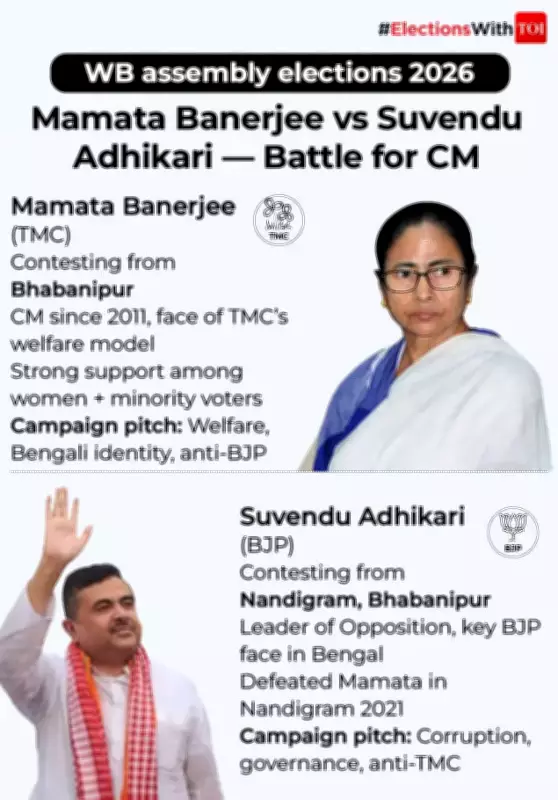
Mamata Banerjee herself will once again contest from the Bhabanipur constituency against BJP rival Suvendu Adhikari, who is also contesting from Nandigram, setting up high-profile electoral duels. The candidate list, announced on March 17, features numerous familiar political leaders including Madhuja, Madan Mitra, and Firhad Hakim, while emphasizing broad social representation with 52 women candidates and 95 candidates from Scheduled Castes and Scheduled Tribes communities.
The BJP has moderated its ambitious 2021 electoral targets but maintains an aggressive campaign posture. Following the backfiring of Amit Shah's "200 paar" slogan in the previous election, the party has established a more realistic goal of 170 seats for Bengal in April 2026. Speaking at a Kolkata rally, Shah asserted, "We will win seats one after another and push the number to 170. The change will come after that."
Campaign Strategies and Political Dynamics
The BJP's campaign focuses on anti-incumbency sentiments and promises of "freedom from fear" under Prime Minister Narendra Modi's leadership, highlighting persistent issues like law and order concerns and employment opportunities. Key electoral showdowns between Mamata Banerjee and Suvendu Adhikari, along with symbolic battles for constituencies like Nandigram and Bhabanipur, represent major campaign themes.

Core campaign strategies echo those deployed in 2021. The TMC continues its extensive door-to-door voter outreach and welfare-oriented messaging, with past initiatives like "Didi Ke Bolo" grievance-mapping and schemes such as Lakshmir Bhandar remaining integral to its political playbook. On the ground, TMC officials report reactivating booth-level agents to counter voter list revisions ahead of the special revision of electoral rolls.
The BJP concentrates on high-voltage political rallies and polarization tactics in urban and Hindu-majority areas. Both political sides are expected to campaign intensively until polling concludes, with minimal restrictions on central security forces likely given the two-phase election schedule.
The I-PAC Raids Controversy
A dramatic episode in January, before the campaign formally gathered momentum, established the confrontational tone for subsequent political developments. The Enforcement Directorate conducted raids on the Kolkata offices of I-PAC and the residence of its chief, Pratik Jain, citing a 2020 money laundering investigation linked to an alleged coal scam.
The Trinamool Congress immediately rejected this explanation. Mamata Banerjee accused the BJP of utilizing central investigative agencies to access confidential campaign strategy documents, alleging that sensitive materials including candidate lists represented the actual target, and directly implicated Union Home Minister Amit Shah.
The confrontation escalated rapidly. According to ED officials, personnel were conducting routine searches until Banerjee arrived with state police and removed materials they described as crucial evidence. Banerjee dismissed the enforcement action as "vendetta crime" and transformed the raids into an early political flashpoint. She led a protest demonstration in Kolkata the following day, accusing the central government of misusing investigative agencies, while party leaders claimed ED officials had attempted to access internal party data.
The BJP and ED have maintained their legal position, accusing Banerjee of obstructing legitimate investigation procedures. The Supreme Court subsequently cautioned the West Bengal government, urging consideration of ED officers' rights and warning against establishing precedents that could affect other states.
Lessons from the 2021 Electoral Battle
The 2021 assembly election marked the definitive moment when the BJP emerged as a serious challenger in West Bengal politics, expanding from the political margins to secure 77 seats and nearly 38% of the popular vote. Yet the election ultimately reaffirmed Mamata Banerjee's political dominance, with the Trinamool Congress securing 213 seats and converting a high-pitched, polarized contest into a decisive victory.
That electoral outcome owed as much to campaign structure as to political instinct. Under Prashant Kishor and I-PAC's guidance, the TMC executed a tightly managed political operation that combined comprehensive voter outreach with real-time feedback mechanisms. Initiatives like Didi Ke Bolo functioned less as conventional messaging tools and more as sophisticated data systems, channeling local grievances directly into campaign strategy and welfare promises.
The BJP's electoral surge demonstrated the scale of the political challenge, while the TMC's strategic response illustrated how effectively that challenge could be managed through systematic campaign architecture.
The Strategic Void in 2026
This election cycle features a quiet but significant strategic absence in the political background. Prashant Kishor, who has since launched his Jan Suraaj Party in Bihar and failed to win any seats in recent assembly polls there, is no longer directly involved. In 2021, Kishor served not merely as a political consultant but as the unseen architect of a campaign that transformed the Trinamool Congress from a besieged political entity into a party that swept back to power with commanding authority.
As West Bengal approaches its 2026 electoral contest, the question persists: Will Mamata Banerjee's campaign demonstrate the same strategic sophistication without Kishor's direct involvement, or will this absence create opportunities for the BJP to narrow the electoral gap? The answer will unfold through the complex interplay of political messaging, ground-level organization, and strategic adaptation in one of India's most politically significant states.





