White House Press Secretary's Viral Photo Sparks Media Access Debate
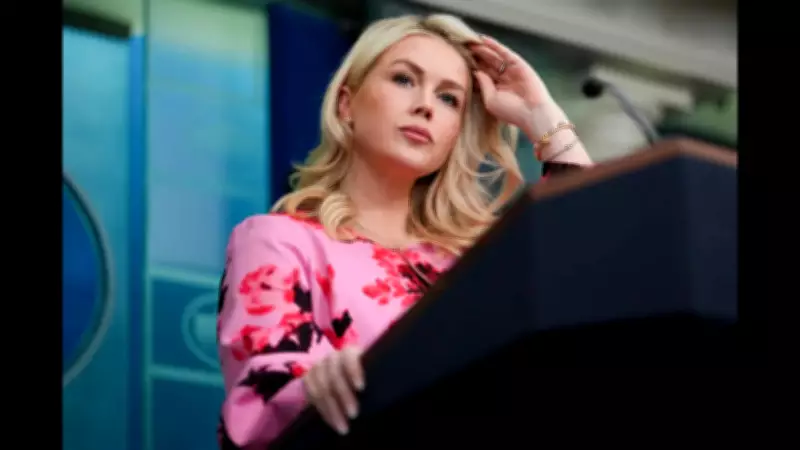
A seemingly simple photograph of White House Press Secretary Karoline Leavitt holding her son while looking at a turkey named "Waddle" has unexpectedly gone viral on social media platforms. The image, captured by Agence France-Presse photographer Andrew Caballero-Reynolds from a low angle, shows Leavitt smiling in a manner that creates a double chin effect, with the turkey prominently featured in the frame.
The Controversial Image Removal
The New Republic reported that this particular photograph has since been removed from both Agence France-Presse's collection and Getty Images' archive. According to their investigation, the "double chin" appearance in the photo was identified as the primary concern that led to its removal from these major photographic agencies.
Agence France-Presse's director of brand and communications, Grégoire Lemarchand, addressed the situation in a statement to The Daily Beast. "While we were made aware that White House staff found the photo unflattering, we want to be clear that there was no formal request to remove it, nor was there any external pressure involved," Lemarchand emphasized, attempting to clarify the circumstances surrounding the image's disappearance from their archives.

A Pattern of Image Concerns
The case involving Karoline Leavitt represents just one instance in what appears to be a broader pattern of concern regarding unflattering photographs of government officials. The Washington Post recently reported that press photographers faced restrictions when attempting to take pictures inside the Pentagon press briefing room, following several media outlets publishing what were deemed "unflattering" photographs of Defense Secretary Pete Hegseth.
This incident occurred on March 2, when Hegseth conducted a press conference alongside the chairman of the Joint Chiefs of Staff to provide details about U.S. and Israeli military strikes on Iran that resulted in the death of Ayatollah Ali Khamenei in February. After wire services distributed photographs from this briefing, Hegseth's staff reportedly expressed dissatisfaction with how the defense secretary appeared in the images.
Pentagon's Response to Media Access
Pentagon spokesperson Kingsley Wilson addressed the media access restrictions in an official statement, explaining that to use the briefing room "effectively," only one representative per uncredentialed news outlet would be permitted inside. "Photographs from the briefings are immediately released online for the public and press to use. If that hurts the business model for certain news outlets, then they should consider applying for a Pentagon press credential," Wilson wrote, framing the restrictions as a matter of operational efficiency rather than image control.
These incidents collectively raise significant questions about the balance between media access to government officials and the control of photographic representation. The removal of the Leavitt photograph from major agency archives, coupled with the Pentagon's restrictions on press photographers, suggests an increasing sensitivity to how government figures are visually portrayed in media coverage.
The situation highlights the tension between journalistic freedom to capture authentic moments and the desire of public officials to control their visual narrative. As social media amplifies the reach and impact of such images, these conflicts between media organizations and government communications teams are likely to continue evolving in the digital age.