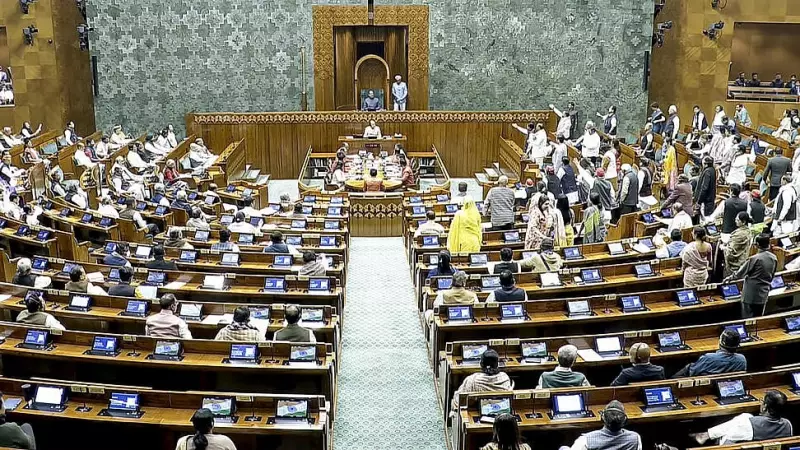
In a session marked by significant political turbulence, the Lok Sabha witnessed the introduction of three crucial legislative bills on Tuesday. The proceedings were dominated by loud protests from Opposition members, who demanded a statement from Prime Minister Narendra Modi regarding the ongoing situation in Manipur. Despite the uproar, Union Home Minister Amit Shah proceeded to table the bills, which are designed to overhaul India's criminal justice framework by replacing British-era laws.
Opposition's Persistent Demand and Government's Legislative Push
The House descended into chaos as soon as it convened for the day. Opposition MPs, united under the I.N.D.I.A alliance, raised slogans and displayed placards, pressing their demand for the Prime Minister to address the house on the Manipur issue. They argued that a discussion on the northeastern state's ethnic violence was a prerequisite for any other parliamentary business. Speaker Om Birla repeatedly urged for order, but the protests continued unabated.
Amid this charged atmosphere, Union Home Minister Amit Shah rose to introduce the trio of bills. The government maintained that legislative work could not be halted. The bills presented were: The Bharatiya Nyaya Sanhita Bill, 2023, aimed at replacing the Indian Penal Code (IPC) of 1860; The Bharatiya Nagarik Suraksha Sanhita Bill, 2023, intended to supersede the Code of Criminal Procedure (CrPC) of 1973; and The Bharatiya Sakshya Bill, 2023, which seeks to replace the Indian Evidence Act of 1872.

Key Provisions and Objectives of the New Bills
The introduction of these bills represents one of the most ambitious legal reforms undertaken in independent India. The proposed legislation seeks to shed colonial vestiges and create a justice system rooted in Indian ethos. The Bharatiya Nyaya Sanhita Bill, for instance, proposes to repeal sedition as an offense, a long-standing demand from various quarters. Instead, it introduces new provisions to deal with acts endangering the sovereignty, unity, and integrity of India.
Other significant changes highlighted include stricter penalties for crimes against women and children, community service as a form of punishment for specific petty crimes, and a formal recognition of electronic records as evidence. The Bharatiya Nagarik Suraksha Sanhita Bill focuses on streamlining criminal procedures to ensure faster justice delivery and greater protection for the rights of citizens. The Bharatiya Sakshya Bill modernizes the rules of evidence to cater to contemporary digital realities.
Parliamentary Impasse and the Road Ahead
The introduction of the bills did little to quell the protests. Opposition leaders, including Congress's Adhir Ranjan Chowdhury and TMC's Sudip Bandyopadhyay, criticized the government for pushing forward with new legislation while ignoring their demand for a discussion on Manipur. They staged a walkout, alleging that the government was undermining parliamentary democracy by not allowing a debate on a critical issue of national importance.
Speaker Om Birla defended the decision to allow the introduction of the bills, stating that the rules of procedure permit such business even during protests, provided there is no formal adjournment motion passed. The bills were introduced and are now expected to be referred to a Parliamentary Standing Committee for detailed scrutiny. This move sets the stage for intense deliberations in the coming weeks of the Monsoon Session, which is scheduled to continue until August 11.
The day's events underscore a deep parliamentary divide. While the government advances its agenda of legal reform, the Opposition remains steadfast in its pursuit of accountability on the Manipur situation. The successful passage of these landmark bills will depend heavily on whether a middle ground can be found to allow the normal functioning of Parliament.